How AI Broke the Job Search for Everyone
Artificial intelligence transformed hiring from a conversation between people into a negotiation between algorithms.
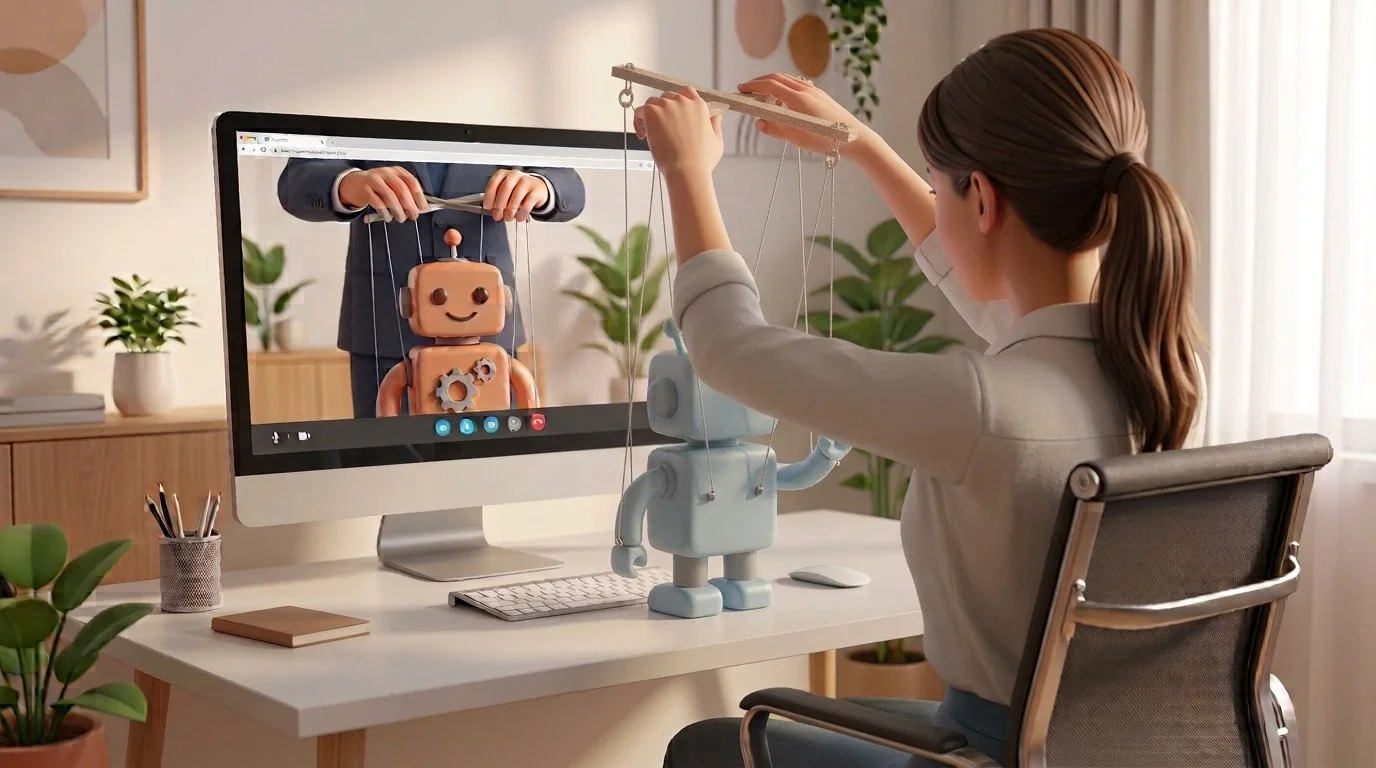
The Invisible Architect of the Modern Interview: AI screening forces both candidate and recruiter to become algorithmic puppeteer - Image generate with Gemini
Over the past year, I have applied for more than six hundred jobs.
That number says as much about today's labor market as it does about me.
I never believed six hundred companies were perfect for me. The economics of recruitment have changed. Applying is now frictionless and both sides have responded by weaponizing automation. Volume has replaced intention.
After two decades in marketing and communications, I found myself navigating a perverse reality: securing a human job requires learning how to speak to machines.
How AI Changed the Job Search
Like millions of other job seekers, I used AI to refine my résumé. It still tells my story, but more clearly. I keep a single version because it represents who I am.
Cover letters were different. AI did much of the heavy lifting, but for the roles I cared about most, I rewrote them myself. For the rest, I relied on it more heavily—I suspect few are ever read by human eyes.
I don't consider this cheating—it is survival. Once employers introduced algorithms to screen us, it was only a matter of time before candidates used algorithms to bypass them.
Artificial intelligence hasn't simply improved résumés. It has standardized them.
Perfectly structured bullet points. Quantified achievements. Impeccable grammar. Carefully optimized keywords. Professional summaries that sound as though they were written by the same career coach—which, in a sense, they were.
The subtle clues that once differentiated candidates—their tone, writing style, and personality—have been flattened into remarkably similar documents.
When everyone appears exceptional, exceptionality itself becomes harder to recognize.
How AI Is Changing Recruitment
Recruitment departments face an impossible arithmetic: application volume has exploded, but hiring staff has not.
AI didn't create the problem of scale. It industrialized it.
According to the Society for Human Resource Management, more than half of organizations already use AI in recruitment. The promise was compelling: automate repetitive work, reduce bias, and give recruiters more time to focus on people.
Efficiency, however, is not the same thing as understanding. AI doesn't simply automate recruitment. It mediates it.
Recent academic research suggests that recruiters still believe they retain control over hiring decisions, yet AI increasingly shapes the information they rely on: how jobs are described, how candidates are summarized, what questions are asked and what counts as a strong answer.
The researchers describe AI as an "invisible architect" of recruitment. The machine rarely makes the final decision. It quietly shapes nearly every decision that follows.
And once the first filter is automated, the consequences become tangible. Unconventional career paths can be penalized, keywords prioritized, real-world problem-solving overlooked, and familiarity rewarded over originality.
The goal was to find the best candidate. Increasingly, it finds the candidate who knows how to look best to the machine.
The AI Arms Race in Hiring
The irony is impossible to ignore.
Recruiters automate because they receive too many applications.
Candidates automate because recruiters automate.
The easier it becomes to apply, the more applications companies receive.
The more applications companies receive, the more automation they introduce.
Neither side fully trusts the other anymore.
LinkedIn's research illustrates how quickly this cycle is accelerating. U.S. applicants per open role have doubled since spring 2022. Meanwhile, 81 percent of people say they have used—or plan to use—AI in their job search, while 93 percent of recruiters plan to increase their use of AI in 2026.
That mutual distrust has created a new market: live interview copilots that suggest answers in real time, alongside auto-apply tools that can send hundreds of applications with minimal human effort.
Companies respond with stricter anti-AI policies and AI detection software.
Every tool designed to restore trust creates another designed to bypass it.
Some employers are going further. Stanford economist Nick Bloom has observed companies bringing candidates back into the room, trying to establish that the person they are interviewing is actually the person doing the work.
The hiring process has come full circle: after adding machines to make sense of people, we are bringing people back in to make sense of the machines.
When Your First Interview Is With AI
For applicants who clear the initial algorithmic screen, the next gatekeeper is increasingly an Automated Video Interview (AVI).
So far, I have been interviewed by AI six times.
You sit before a blank lens, positioned like a patient under a diagnostic scanner. A prompt appears. A digital timer ticks down. You speak into the screen without receiving a smile, a raised eyebrow, or any signal that a human being is listening. There are no vital signs of real interaction—only the quiet background processing of software analyzing your cadence, syntax, and facial telemetry.
The first time was oddly fascinating. By the sixth, it felt like an endurance test inside a sensory-deprivation chamber.
And I’m not alone. More than 60 percent of applicants describe one-way AI interviews as deeply dehumanizing, with many dropping out rather than performing for a screen.
Traditional interviews were mutual evaluations; you weighed the company’s culture while they weighed your skills. You could ask questions, observe reactions, and sense whether they wanted to work with the people across the table.
AVIs destroy that symmetry making the hiring process more impersonal, opaque and vulnerable to manipulation.
You aren't participating in an exchange—you are submitting to a diagnostic extraction.
When AI Mistook Me for AI
In another recruitment process, I was asked to answer multiple open-ended questions in writing. The instructions explicitly stated that AI could not be used.
I wrote carefully, drawing entirely on my own experience and professional background.
Before submitting, mostly out of curiosity, I ran my answers through an AI detector.
The result: a 38 percent probability that my writing had been generated with AI assistance.
I laughed.
Then I became genuinely frustrated.
Writing is not a peripheral skill in my profession. It is my profession. I have spent two decades crafting campaigns, articles, corporate communications, and brand narratives.
Yet the detector flagged my natural fluency as suspicious.
To reduce that score, I rewrote my answers. Not to make them clearer. Not to make them stronger. I deliberately made them worse. I simplified the vocabulary. Shortened the sentences. Removed stylistic rhythm. Flattened the language until it sounded less like me.
Somewhere in that process I realized I was no longer trying to communicate well. I was trying to communicate badly enough to convince a machine that I was human.
The entire exercise felt absurd. I had to sound less like myself to prove that I was myself.
The New Skill: Performing for AI
Over the past year, I have learned how to optimize résumés, tailor cover letters, speak to AI interviewers, and write in ways that pass detection systems.
Should I put those skills on my résumé?
I am not sure they make me better at my work. They make me better at getting through the process.
In my previous article, I asked what remains valuable when AI can perform so much of what humans once did. I argued that judgment, discernment, taste and trust become more valuable as machines become better at producing.
Looking for work has made that argument impossible to ignore.
Because the unsettling part is not that machines are learning to evaluate us.
It is that we are learning to perform for them.
