Nothing We’re Building Is New
Ancient Crete and the Illusion of Innovation A Future That Already Existed
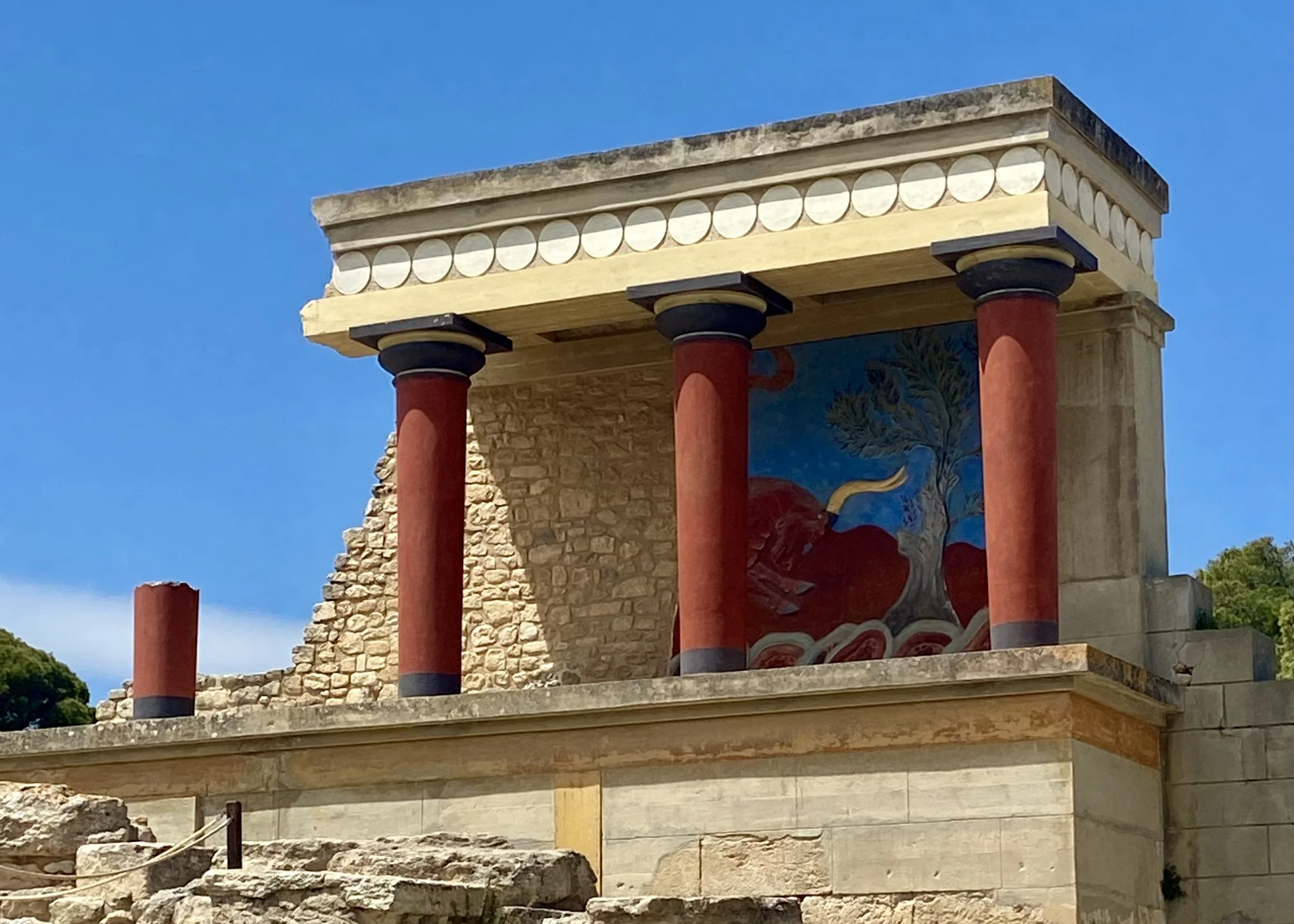
What we see at Knossos is not the past as it was—but the past as we were able to reconstruct it.
We talk about smart cities. About global networks, data systems, resilient infrastructure, and algorithmic decision-making.
We assume these are new problems. New inventions. New frontiers.
They are not.
Four thousand years ago, on the island of Crete, a civilization was already experimenting with many of these same ideas: distributed networks, data recording, urban planning, and power built on connectivity rather than force.
We do not think of it this way because we no longer fully understand it.
Power Without Walls
The Minoan civilization (c. 2700–1450 BCE) is often described as one of the earliest foundations of European culture. More precisely, it was a large-scale experiment in organization—economic, social, and spatial.
Unlike its contemporaries, it did not rely primarily on military expansion. Its power moved through the sea—a form later described as thalassocracy.
What is most striking, however, is what is missing. Major Minoan centers show little evidence of defensive walls. In a world where security was typically built in stone, this absence stands out. While Mycenaean and Mesopotamian cities fortified themselves, Crete appears exposed. And yet, it was not weak.
Its influence moved through networks: trade routes linking Egypt, the Levant, and Anatolia. Goods, techniques, and ideas circulated continuously. Power was not projected through control of territory, but through control of movement.
From within, such a system would have felt stable. Even resilient. A society without walls can be read as trust. Or as confidence. But it can also suggest that defense has shifted elsewhere—into economic leverage, maritime control, and access to networks.
What appears open may still be structured. What appears stable may depend on a balance that is difficult to maintain. We tend to call this globalization. But that is our language, not theirs.
The Invisible Architecture
That external network was mirrored internally. Ancient Crete did not function as a collection of isolated settlements. Ports, cities, and inland centers formed an integrated system of exchange. Resources were collected, stored, and redistributed. Movement was designed.
Beneath this circulation was coordination: storage, administration, and infrastructure were not separate layers but part of a single logic—an early form of systemic organization that feels unexpectedly familiar. This required tracking and record-keeping. For that, the Minoans used a script we still cannot read: Linear A. It appears in inventories and administrative records. We can catalog its symbols, analyze patterns, digitize its structure. But we cannot understand it.
The data survived. The meaning did not.
This is not unusual. It is structural.
We tend to assume that more information leads to more understanding. But systems depend not only on data—they depend on context, shared frameworks, and implicit rules that rarely survive.
From within, the system was legible. From the outside, today, it is fragmented. Not because it lacked coherence — but because that coherence no longer translates.
Designed to Be Lived In
The Minoan system was not only efficient. It was livable. Urban design integrated water management, drainage, and sanitation directly into architecture. Buildings were constructed with flexibility suited to a seismic environment. Space was planned—not just occupied. Function nevertheless was not separated from aesthetics. Frescoes, color, and open courtyards were not decorative layers. They were embedded in the system itself. The same structures that enabled coordination also shaped experience.
Function and aesthetics were part of the same logic. This integration extended into representation. Female figures appear prominently in Minoan imagery—active, visible, central. Whether this reflects actual social structure or symbolic projection remains unclear. But the signal is there: participation was not only functional. It was expressed.
The system was designed not only to work, but to be lived.
Infrastructure was not hidden. It was felt.
When Complexity Fails
For all its sophistication, the Minoan world did not endure.
Crete sits on a seismic fault line. Earthquakes were not anomalies, but conditions. Even advanced construction could not fully mitigate them. The eruption of Thera, one of the most powerful volcanic events in the Mediterranean, disrupted the environment and destabilized trade routes. Interdependence became vulnerability.
External pressures followed. A system built on flows could not function once those flows were interrupted. It did not collapse because it was simple. It failed because it was complex.
Complex systems increase efficiency and reach. But they also depend on conditions that must continuously hold. The more interconnected they become, the more sensitive they are to disruption.
From within, they feel stable. From the outside, in retrospect, their fragility becomes obvious.
What remains is not the system — but its traces.
What We See Is Not What Was
What we see today is not untouched. Nowhere is this more visible than at Palace of Knossos. The past has been reconstructed—literally. In the early twentieth century, Sir Arthur Evans did not simply uncover the ruins — he completed them. Using concrete, symmetry, and aesthetic choices shaped by his time, he transformed fragments into a coherent whole. Walls were raised. Colors were added. Forms were resolved where evidence was missing.
The result is persuasive. Coherent. Almost convincing. But coherence is not the same as truth.
What we encounter is not the Minoan world as it was, but a version made legible.
This is not unique to archaeology. Modern AI systems operate in the same way. They do not access reality directly. They rely on partial datasets—recorded traces shaped by prior decisions. From these, they generate outputs that appear consistent and complete.
Like Knossos, they are reconstructions. Not of what is, but of what can be inferred.
The smoother the output, the harder it becomes to see the gaps.
This is not a failure of data. It is a limit of interpretation.
This Will Happen to Us
It is tempting to believe that we understand our own systems. They are documented, measured, stored. We assume that accumulation guarantees understanding. But every civilization believes it is advanced. Until time reframes it.
What we call innovation today, will become material for interpretation—fragments, records, infrastructure without context.
If our systems were to stop functioning, what would remain would not be experience, but traces — data, devices, infrastructure, written in forms that may no longer be readable.
Information does not preserve understanding. It preserves the possibility of interpretation. And interpretation is never neutral.
We are not building complex systems for the first time. We are repeating a pattern — at a different scale, with different tools. We are not building the future as we imagine it. We are producing the remains that someone else will try to understand. Just not in the way we expect.
