Innovation needs Culture
Technology expands possibilities. Culture decides which ones matter.
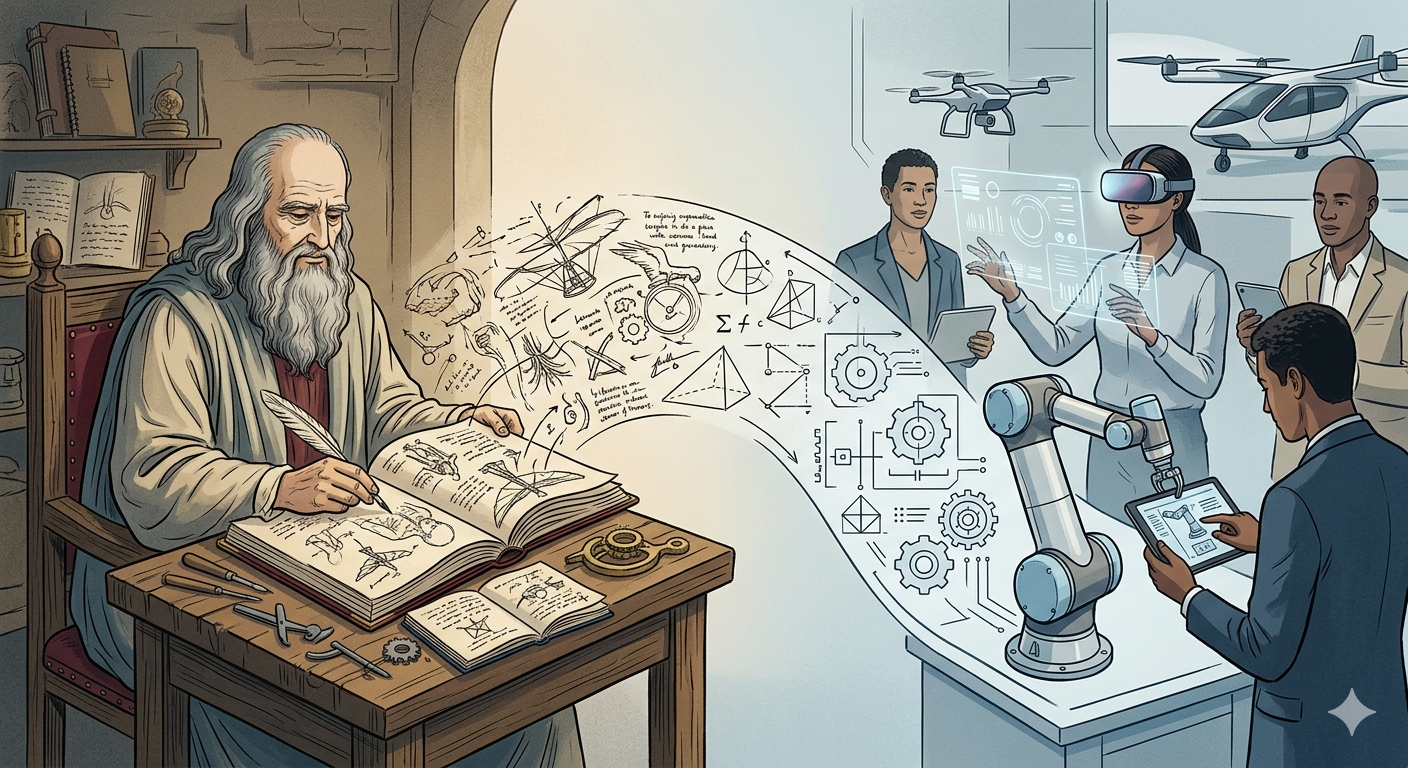
The timeless thread of human ingenuity, bridging da Vinci’s visionary notebooks with the cutting-edge worlds of robotics, AI, and aerospace engineering. Illustration generated with AI
Perception shapes innovation
Innovation is often treated as a technical problem - something to be solved with better engineering, more data, or faster computation. That framing is incomplete.
What we build is not only a function of what we can do, but of what we choose to see. Culture defines that field of vision. It determines which problems appear urgent, which solutions feel acceptable, and which possibilities are ignored altogether.
When culture gets it wrong, innovation follows. Technologies emerge that are precise but misplaced, efficient but irrelevant, advanced but unused.
Imagination precedes invention
Innovation does not start with solutions. It starts with the way we perceive the world - how a problem is framed, how a future is imagined. Before technologies become real, they are imagined in literature, in art, and in speculative thought.
In 1909, E. M. Forster (The Machine Stops) described a world of isolated individuals, communicating through screens and relying on a global machine for everything. More than a century later, it feels strangely familiar.
The technology was fictional. The perception was not. Imagination does not predict the future, but it defines the boundaries of what can be recognized once it arrives.
Interpretation enables adoption
Between invention and adoption lies a step that is often overlooked: interpretation. Technology does not enter society as neutral capability. It has to be understood before it can be used.
Artists frequently occupy this space first. They do not refine systems; they expose them. They test how technology behaves in human terms - how it moves, how it feels, how it relates.
In recent performances in Chinese New Year celebration, humanoid robots execute synchronized dance and martial arts routines with a level of control that would have seemed unlikely a year ago. The technical progress is substantial, but the framing matters more. Presented as choreography rather than engineering, the system becomes legible. What would be opaque as code is understood through movement.
People rarely adopt what they don’t understand, and they never embrace what they don’t feel.
China's humanoid robots perform incredible martial arts stunts for Chinese New Year
Bridging the gap
The failure of many technologies is not technical. It is relational. There is often a gap between those who build systems and those expected to use them.
Closing that gap is not a matter of simplification, but of alignment. Complexity does not need to be reduced; it needs to be made perceptible. Making systems visible, tangible, and meaningful—is a critical part of innovation.
When that does not happen, even capable technologies remain unused - not because they fail, but because they never connect.
Context defines value
This distance becomes even more visible across different cultures and contexts. The same technology does not carry the same meaning everywhere. It enters environments shaped by infrastructure, expectations, and social norms.
Electric vehicles, for example, are a practical solution in regions with dense charging networks. Without that infrastructure, they become impractical regardless of their technical advantages. Advanced medical devices can extend lives, but only where systems allow access. Elsewhere, they reinforce the gap between those who can benefit from innovation and those who cannot.
Even widely publicized products can fail on contact with social reality. Google Glass did not collapse because of insufficient engineering. It failed because it introduced friction—social, ethical, and behavioral - that had not been resolved.
These are not edge cases. They are typical outcomes when context is treated as secondary.
Ethics is structural
Technology is not neutral. Systems reflect the data and assumptions on which they are built - social, economic, cultural. They reflects priorities, power structures, and assumptions - often invisible, but deeply embedded.
Systems trained on historical data inherit the biases within them. In hiring, algorithmic models have repeatedly reproduced patterns of exclusion - filtering candidates along lines of gender or ethnicity while maintaining the appearance of impartiality. The issue is not a technical error. It is a structural one.
Ethics, in this sense, is not a limitation imposed after the fact. It is a condition of design. Without it, systems scale existing inequalities with greater efficiency.
Culture provides direction
Culture is not an accessory to innovation. It is what gives it direction. It shapes how technologies are interpreted, whether they are trusted, and how they integrate into daily life.
A system does not become useful when it functions. It becomes useful when it fits - when it aligns with how people think, behave, and decide.
Innovation is not only the creation of new tools. It is the construction of the conditions in which those tools make sense.
Technology expands what is possible. Culture determines what is built, what is adopted, and what is left behind.
