The Gods We Scroll
The hidden system behind influencers, platforms, and the industrialization of attention
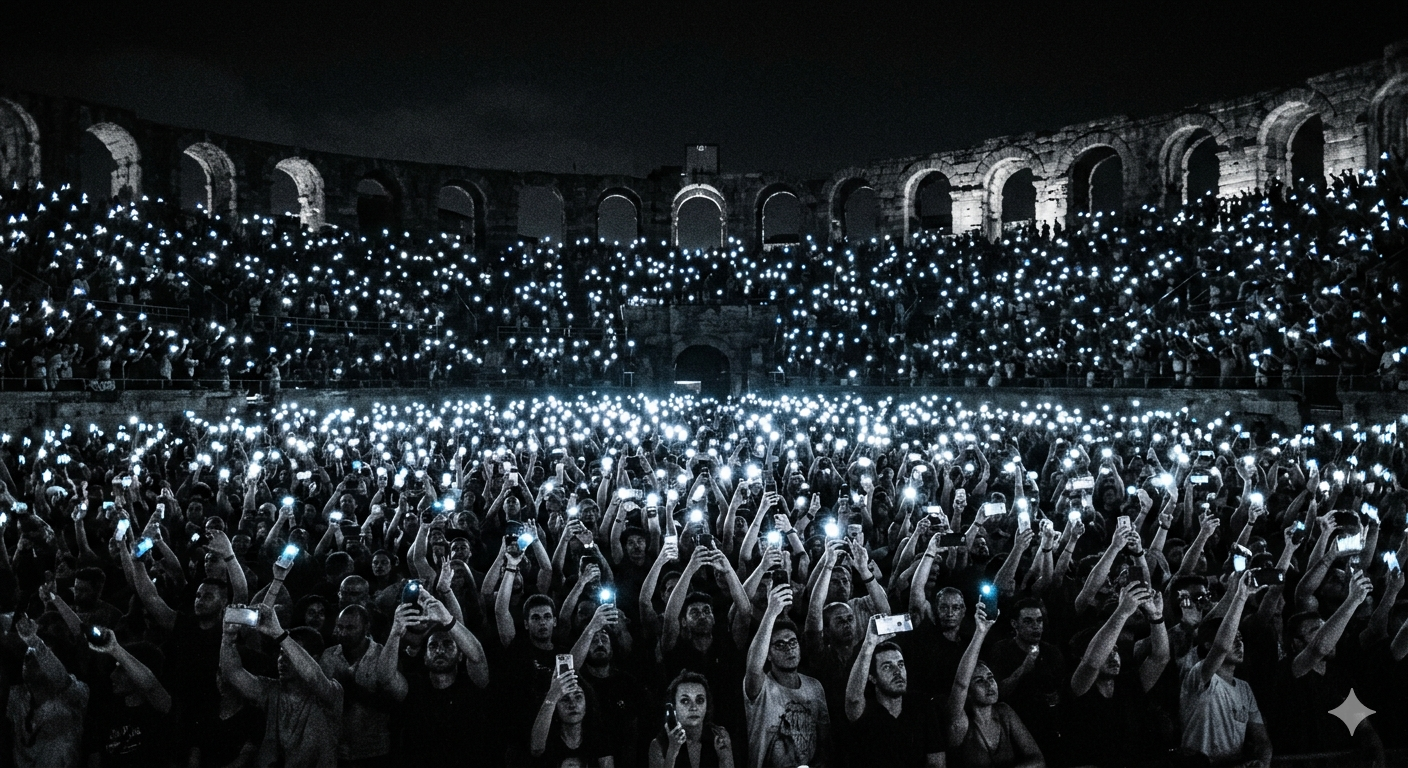
The Digital Arena: Attention in the Digital Age
Attention is no longer something we give. It is something extracted.
In the digital economy, influence is not an accident of charisma or talent—it is a function of infrastructure. Platforms compete to capture human focus, brands compete to buy it, and influencers have emerged as the most efficient mechanism for converting attention into value. What looks like culture is, increasingly, a market.
The First Infrastructures of Attention
Long before algorithms, societies organized themselves around figures who concentrated attention. Authority was reinforced not only through institutions, but through carefully constructed public rituals. Temples, agoras, and theaters became infrastructures of attention—spaces designed to attract and hold the gaze of the many on the few. People came not only to worship, but to watch, to participate, to belong.
What moved through these spaces was not just devotion, but collective focus—organized, repeated, and, in its own way, controlled. To shape attention was, in effect, to shape the crowd itself: a population is easier to guide when its gaze is directed.
The Illusion of Intimacy
The logic has not changed—only the medium. The smartphone has become a kind of shrine.
Through it, millions enter parasocial relationships: one-sided bonds in which attention, emotion, and time flow in a single direction. Human cognitive bandwidth remains limited, yet platforms systematically concentrate it around a small number of hyper-visible figures, intensifying the asymmetry between attention and connection.
Platforms are designed to simulate proximity. Stories, livestreams, and comments create the impression of access, collapsing distance without eliminating it. Followers engage in low-intensity rituals—watching, liking, commenting—that sustain interaction without ever completing the relationship. These bonds can resemble friendship, mentorship, even devotion. But they remain structurally non-reciprocal. It’s just emotional projection in a digital world.
Performing Authenticity
Why does it work so well? Even those who claim indifference can recall dozens of names, faces, fragments of lives. Familiarity accumulates quietly—and is easily mistaken for truth.
The performance of authenticity has become more valuable than authenticity itself. As Erving Goffman observed, social life has always involved performance. What influencers have mastered is the simulation of the “backstage”—the private, unfiltered self. Carefully curated glimpses of vulnerability and imperfection create the impression of honesty, even as they are deliberately constructed.
This performance is not incidental—it is labor. Influencers sustain attention by managing emotion, intimacy, and perception in real time. The more authentic the connection appears, the more valuable it becomes.
Audiences feel close enough to admire, but also entitled to critique, correct, and even punish. Judgment becomes a form of participation—and participation, in this system, is value.
We Don’t Know What We Want
All of this unfolds within a system that is increasingly precise, measurable, and extractive. Attention—finite and deeply human—has become the primary currency. Platforms do not simply host content; they engineer feedback loops that maximize engagement and generate vast quantities of behavioral data. Every interaction refines the system’s ability to predict and shape desire.
We do not just watch influencers—we model ourselves on them. As René Girard argued, human desire is imitative. We learn what to want by observing others.
The implication is more unsettling than it first appears: we don’t actually know what we want.
In an environment of constant exposure and algorithmic reinforcement, desire becomes recursive. We adopt preferences that are already shaped, validated, and amplified by the system. Influencers function as visible templates of success, collapsing the distance between aspiration and identity. They are not unreachable celebrities, but possible futures—models not just of what to have, but of what to be.
Influencer Creep
Being an influencer is framed as sovereignty—the promise of being oneself and being rewarded for it. A modern definition of freedom. That logic is no longer confined to influencers.
Researchers have begun to describe this shift as “influencer creep”: the spread of self-branding practices into professions—art, medicine, law—once removed from the logic of visibility. The techniques of influence—curation, performance, constant presence—become less optional and more structural. To remain visible is to remain viable. Individuals across industries begin to operate as micro-brands, performing versions of themselves designed to attract and sustain attention.
The Economics of Influence
Influencers, in this sense, are not outliers. They are prototypes.
They operate as micro-enterprises built on personality as infrastructure, converting attention into what is often called “celebrity capital.” The system is straightforward: audiences supply attention and emotional investment; platforms capture and refine it into data; brands purchase access to it. Influencers sit at the center, transforming attention into trust, and trust into monetizable action. The scale is significant. The industry now exceeds $30 billion globally, with brands earning, on average, more than $5 for every $1 spent. In this economy, attention is not just captured—it is priced, predicted, and sold.
When Influence Stops Being Human
In less than two decades, influence has moved from mass media to personal feeds, from distant celebrities to intimate creators, and now toward synthetic personas.
AI is already generating digital personas that never tire, never age, and can be endlessly optimized. These entities do not introduce a new logic—they extend an existing one. If authenticity can be performed, it can be replicated.
Platforms optimize relationships as much as content, turning engagement into a predictable output. Authenticity itself has been standardized into recognizable signals, increasingly legible to machine replication. What emerges is not the disappearance of the influencer, but the industrialization of persona. Identity becomes a configurable interface, tuned for engagement. As content approaches zero marginal cost, value shifts toward distribution, trust, and control over attention.
The paradox is that awareness of artificiality does not weaken attachment. It may intensify it. If authenticity was always, in part, constructed, AI does not introduce fabrication—it removes its last constraint. What is being displaced is not truth, but the assumption that truth was ever the mechanism of attention.
What, then, is lost when the human disappears?
We have moved from worshipping the distant, to following the familiar, to engaging with the engineered.
Influencers are not a cultural anomaly. They are the latest expression of a much older system—one that converts attention into power.
We did not invent influencers. We industrialized attention. What began as charisma has become infrastructure—and infrastructure does not require a face.
