When Some Members of Society Aren't Human
Humanoid robots are entering public life. Will participation in society remain tied to being part of it?
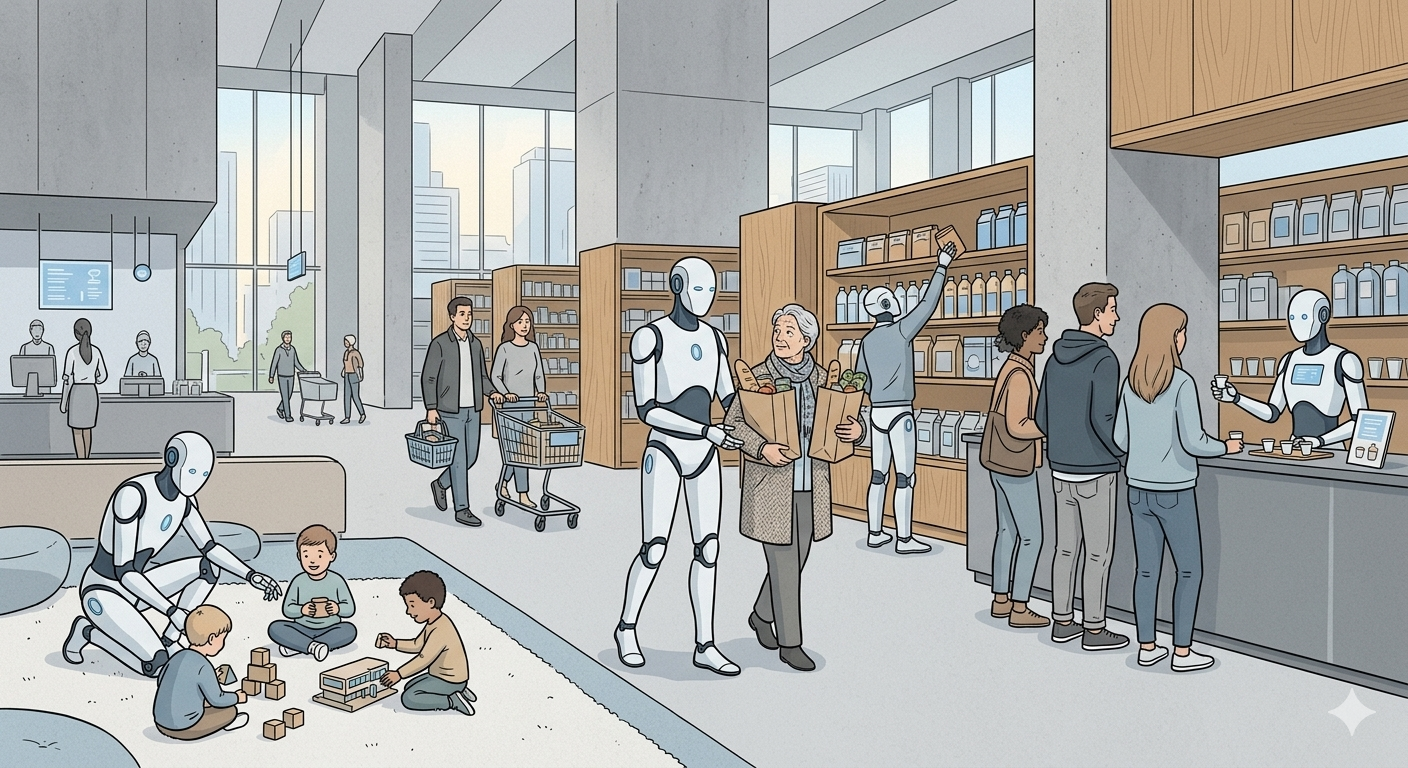
As humanoid robots quietly assume public roles, society begins to reorganize its physical and moral architecture around their presence. Image generated with Gemini
The Rise of Humanoid Robots in Public Spaces
Humanoid robots have officially stepped out of sci-fi graphic novels and off movie screens into the real world. They are no longer a distant concept. Today, we encounter them in airports, hospitals, hotels, and other public environments where strangers routinely interact and depend on one another.
Their presence is still limited, often experimental, sometimes awkward. But it is also increasingly normal in a way that feels less like disruption than quiet extension—another layer added to existing systems of coordination and service.
This shift is easy to describe in technical terms: automation, efficiency, labor substitution. Yet what we must notice is not only how work is done, but who—or what—participates in the routines that structure public life.
From Novelty to Infrastructure: Normalizing Autonomous Systems
Every transformative technology follows the same path: novelty, disruption, normalization, invisibility. We no longer marvel at elevators. Or electric lights. Or internet routers. We only notice them when they stop working.
Humanoid robots will follow the same path. The first robot receptionist attracts attention. The thousandth becomes routine. The hundred-thousandth becomes infrastructure.
And that may be the moment when the real transformation begins.
Once these machines fade into the background architecture of everyday life, society will no longer ask whether machines belong in public spaces. It will simply—and quietly—begin reorganizing itself around their presence. And that is precisely the moment when the real transformation begins.
Public Roles Without Human Membership
Participation in society has implied membership in it. Not in a formal political sense alone, but in a practical one.
We navigate public life under the assumption that the people around us possess intentions, emotions, and moral agency. We rely on those assumptions to resolve conflicts, assign responsibility, and build trust. Ultimately, we trust others because we assume they can be held responsible for how they behave.
Humanoid robots, however, break this connection between trust and accountability. The interaction with them feels social, but the underlying structure is different. A humanoid can maintain seamless continuity—remembering preferences, responding consistently, and adapting to context—yet it cannot truly reciprocate trust because it lacks moral agency. It cannot owe obligations, be persuaded, forgiven, or held accountable.
This shift is not a simple one-to-one replacement of human labor. Rather, certain public roles are becoming detached from human membership while still retaining their social function.
The Commercialization of Social Trust
Factories automated labor. Software automated information. Humanoids automate parts of social participation itself. The risk is not that robots become human; the risk is that trust becomes commercialized.
Through continuous interaction, a robot can easily simulate intimacy. It remembers your preferences, greets you by name, and remains endlessly patient, attentive, and polite. Over time, these interactions inevitably begin to feel familiar and dependable. Yet, unlike traditional social relationships, the machine is never acting on its own behalf. Behind every gesture sits an employer, a manufacturer, or a digital platform.
The robot may appear neutral, but its behavior ultimately serves objectives defined elsewhere. The same system that knows how to make an interaction comfortable may also know how to influence decisions, guide attention, and shape behavior. For the first time, we may find ourselves placing social trust in entities that are owned, operated, and continuously optimized by private institutions.
Surveillance Disguised as Assistance
To function effectively, a humanoid robot must constantly observe. It maps environments, recognizes faces, tracks movements, and processes subtle behavioral signals. Yet, unlike a static camera mounted on a wall, it does not merely watch: humanoid robot participates.
Here, data collection is woven directly into the mechanics of hospitality or care. A simple conversation becomes a simultaneous social exchange and a data-harvesting event. The question is no longer whether information is being collected. It is who owns it, who controls it, and whether meaningful consent is possible when surveillance arrives disguised as assistance.
When Bias Acquires a Body
For years, algorithmic bias remained largely confined to screens. Humanoids make that discrimination physical.
A translation tool that misunderstands an accent is frustrating. A physical robot that misinterprets a cultural gesture, a disability, or an emotional create consequences in real space. A machine might misread a user's intent, incorrectly restrict physical access, or misclassify a normal human reaction as a threat.
As robots enter public life, we must confront a difficult reality: algorithmic bias does not disappear when it acquires a body. It becomes more visible. And potentially more consequential.
The Categorical Blindspot of the EU AI Act
Regulators are rushing to meet this challenge.
Under the European Union's AI Act, many AI systems deployed in healthcare, education, employment, and public-facing environments are classified as high-risk, triggering strict demands for transparency, documentation, and human oversight.
While these measures address vital concerns around data privacy and safety, they suffer from a fundamental architectural flaw: current regulatory frameworks still treat humanoid robots either as industrial tools or as physical extensions of software.
Our legal institutions were designed for an world split cleanly between people and products. Humanoid robots fit into neither category. The law can regulate how a machine functions, but it cannot govern the kinds of relationships that machine produces.
This is the quiet transformation underway. We are not witnessing a sudden replacement of human interaction, but rather the gradual emergence of a shared public space—one where social participation and human membership are no longer the same thing.
Designing a Society for Co-Presence
The challenge posed by humanoid robots is not primarily technical. It is social.
We already know how to build machines that can navigate buildings, answer questions, carry objects, and smoothly interface with strangers. We are far less certain of how those interactions will reshape the core assumptions upon which modern civilization was built.
For thousands of years, every participant in public life was human. That is no longer guaranteed.
The coming decades will test what happens when some participants in our workplaces, schools, hospitals, and neighborhoods share our spaces but not our humanity.
Robots are entering our social infrastructure whether we are prepared or not.
