AI Companionship and the Future of Care
What Happens When We Outsource Empathy?
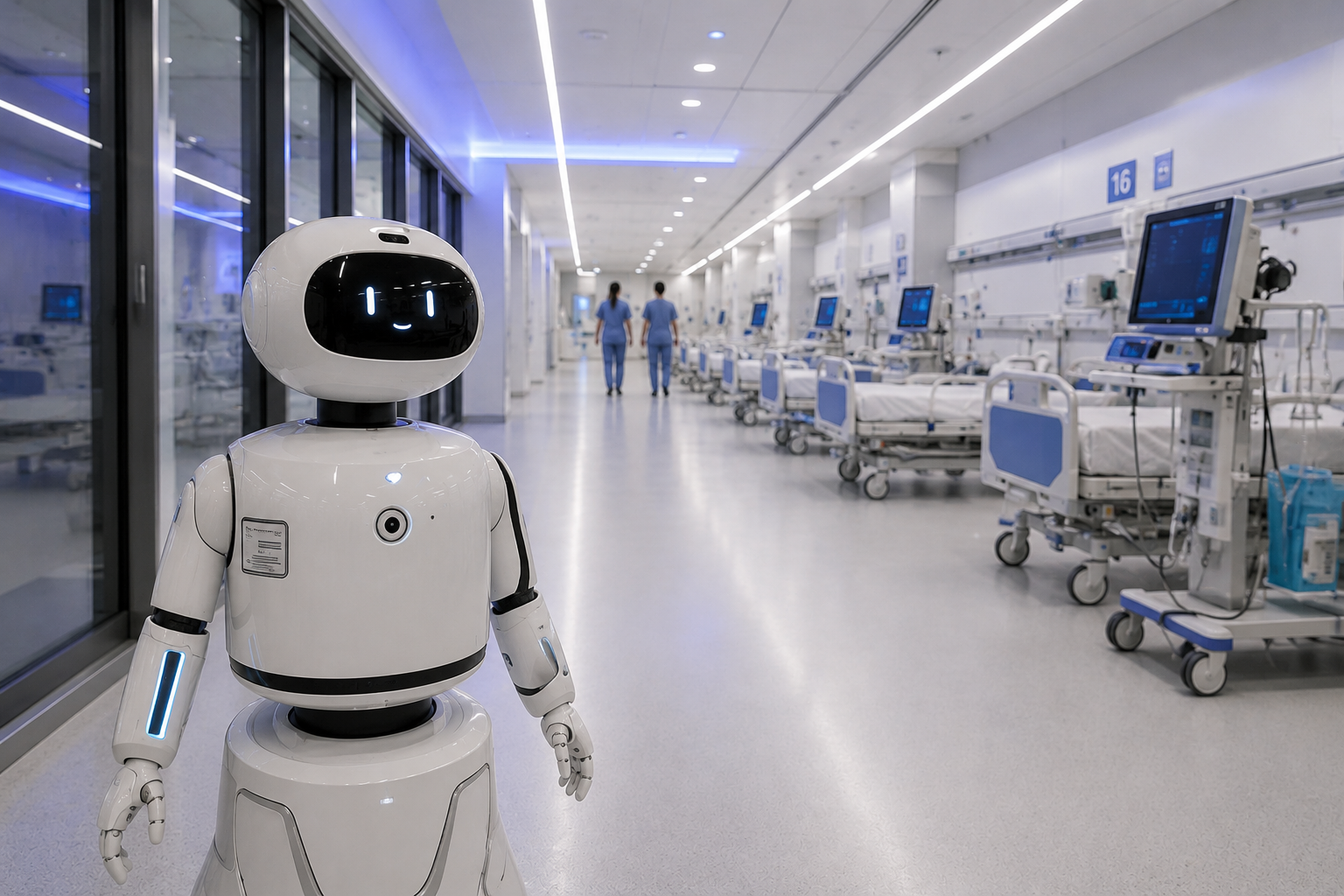
AI companions and care robots become more common in healthcare settings. Can technology support human care without replacing the relationships that give care its meaning?
One of the fastest-growing markets in artificial intelligence is not productivity.
It is companionship.
Across the world, robots are entering nursing homes, conversational systems are being “prescribed” for loneliness, and AI companions are becoming a quiet feature of everyday life. Technology companies frame these tools as answers to urgent crises: caregiver shortages, aging populations, and rising social isolation.
Yet the timing is disquieting. At the very moment human connection feels more fragile, we are investing heavily in technologies designed to simulate it.
The question is no longer whether machines can help us care for one another.
The question is what this says about the societies that need them.
The Anatomy of Care
Care is often treated as a single concept. In reality, it is a bundle of different activities.
Some are practical: administering medication, monitoring health conditions, helping someone eat, bathe, or move safely through the world.
Others are emotional: listening patiently to the same story for the tenth time, offering reassurance during moments of fear, remaining present when there is nothing left to fix.
Beneath both lies something less visible: responsibility. Care means another person's well-being matters enough to command attention, patience, and continuity.
This distinction matters because technology is already capable of reproducing certain outcomes of care. Machines can remind patients to take medication, detect falls, track vital signs. Increasingly, it can even engage in conversations that feel supportive and attentive.
But this raises a deeper question.
If many functions of care can be automated, what exactly was care in the first place?
A set of tasks—or a relationship that gives those tasks meaning?
The Invisible Economy of Care
The rush to automate care is not just a triumph of engineering. It is a symptom of a deeper social failure.
Care has always sustained human life while remaining economically invisible. Raising children, caring for aging parents, supporting relatives with disabilities, and providing emotional stability have often been treated less as skilled labor than as moral obligation. Historically, much of this work fell to women.
Even as care moved into hospitals, nursing homes, and formal institutions, its status barely changed. It remains among the most essential yet least rewarded forms of labor.
Today, the contradiction is impossible to ignore. Populations are aging, caregiver shortages are widening, and burnout is widespread across health and social services. The World Health Organization estimates a global shortfall of roughly 11 million healthcare workers by 2030.
The result is a peculiar form of technological urgency. We claim that care is priceless, yet we consistently refuse to pay for it. Because we have spent decades devaluing this vital labor, we are now turning to technology to bail us out of a crisis we chose to create.
The care crisis is not creating robots.
The care crisis is creating demand for them.
NAO robot helps children on the autism spectrum build essential communication and life skills.
The Robotic Frontier: Support Tool or Budget Cut?
Robots in care settings are no longer hypothetical.
Devices like PARO, a robotic seal used in dementia care, and ElliQ, a conversational companion for older adults, are being deployed in nursing homes and assisted-living facilities. Humanoid robots such as NAO and Pepper appear in classrooms, autism programs, and elder-care initiatives.
Recent clinical research from the University of Victoria suggests these social robots can reduce anxiety, support dementia patients, and ease pressure on overstretched clinical teams.
Most are not designed to replace caregivers outright. They perform narrower functions: reminding patients to take medication, encouraging interaction, monitoring routines, or providing companionship during long periods of isolation.
Viewed optimistically, they function as powerful support tools. By absorbing repetitive tasks, they free human caregivers to focus on judgment, presence, and emotional connection.
Viewed pessimistically, they become cost-cutting tools. In underfunded care systems, “support” quietly turns into substitution. A robot introduced to assist care can be used to justify hiring fewer humans. Human presence becomes a premium feature rather than a baseline expectation.
The technology is not the central issue.
The question is whether robots will help societies value care more—or simply help them provide less of it.
Baby Seal PARO is a therapeutic robot, designed to have a positive psychological effect on people who interact with it.
The Industrialization of Empathy
The most disruptive feature of care robots is not their mobility, intelligence, or efficiency.
It is their ability to simulate concern.
Modern AI systems are trained on enormous datasets of facial expressions, speech patterns, and behavioral cues associated with human emotions. They learn to recognize distress, respond with appropriate emotional cues, and sustain the feeling of being attended to. They do not feel empathy—they perform it.
For the recipient, that distinction can be surprisingly difficult to detect.
This raises one of the central ethical questions of AI companionship: if simulated empathy reduces suffering, does its artificiality matter?
Some argue that genuine care requires a subject—someone capable of concern, responsibility, and moral commitment. Others counter that outcomes matter. If a lonely person feels less isolated, if an anxious patient feels calmer, if a child becomes more engaged in learning, why should the source matter?
Beneath the technological debate lies a deeper cultural one.
We are beginning to deploy emotional support robots for children and companion robots for older adults at the exact moment human connection itself is becoming scarce. We are bookending human life with artificial relationships.
In trying to automate care, we may be revealing how thin the real thing has become.
What Are We Valuing All Along?
Societies have always treated care as both essential and expendable. Essential because no human life survives infancy, illness, or old age without it. Expendable because those who provide it are often underpaid, overworked, and invisible.
AI companionship and care robotics expose this contradiction more sharply than ever.
If attentiveness, reassurance, presence, and even empathy can be partially automated, then the question is no longer what machines can do.
It is what humans were valuing in care all along.
Was care just a set of outcomes delivered efficiently?
Or was it the knowledge that another person chose to devote their time, attention, and responsibility on us?
The future of care will not be decided by robots.
It will be decided by whether societies finally decide that the humans who provide care are not interchangeable with the machines now learning to imitate them.
