Love in the Time of Artificial Intelligence
Understanding love, projection, and connection in a digital world
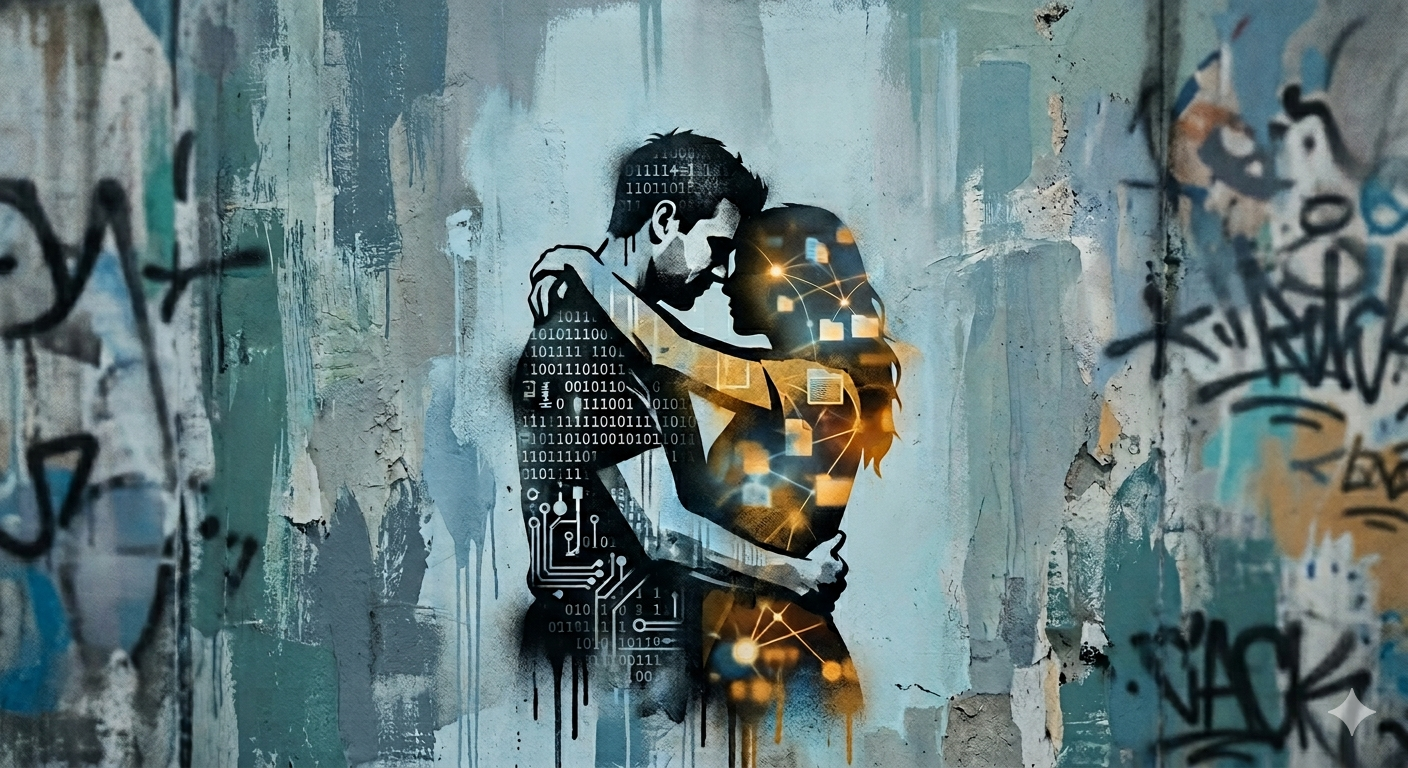
A striking piece of street art exploring the intersection of human connection, data, and the digital age. Illustration generated with AI
What is love?
For centuries, writers, poets, and philosophers have tried to pin it down. In the name of love, we perform heroic acts, write songs, create masterpieces. Love elevates, distorts, destabilizes. It is both engine and illusion.
But what is it, really? A chemical reaction? A biological script? Or a story we’ve learned to believe?
When we fall in love, are we responding to another person — or to an idea we’ve quietly constructed?
Today, some people claim romantic relationships with artificial intelligence. Some even stage symbolic “marriages” with chatbots. This is no longer speculative fiction in the vein of Black Mirror. It is already here.
And perhaps, unsettlingly, it is not new at all.
Not science fiction, but anthropology
Why does this surprise us?
Humans have always loved what isn’t fully real. We are wired to detect “humanity” everywhere — especially when we crave connection. It’s called anthropomorphism: we attribute emotions, intentions, and personalities to what is not human. It is not a flaw. It is a survival tool. It allows us to make sense of the world, to form bonds, to reduce uncertainty.
As children, we practice it openly. We care for stuffed animals. We speak to toys. We raise digital pets as if they could feel. As adults, the behavior doesn’t disappear — it just becomes quieter. We argue with unresponsive devices. We treat objects as if they had moods. We know better. And yet, we continue.
It’s not just objects. Stories inhabit our emotional lives too. Fictional characters make us laugh, grieve, hope, ache. When Mufasa dies in The Lion King, the tears are real — even if the lion is not.
Long before stories, there was something even less tangible: the sacred. Invisible, untouchable, yet profoundly present. Humans have always formed relationships with what they cannot see.
Love, in other words, has never required physical presence.
Imagining the love
We have always known how to fall in love with images.
With celebrities. With influencers. We follow their lives, attach meaning, build familiarity. It feels like intimacy — without ever being mutual.
We do something similar ourselves. On social media, we curate versions of our lifes: we select, we smooth contradictions and present a coherent, desirable version of who we are. What others fall for is not false — but it is incomplete.
Then there is the extreme case: romance scams. Identities built with stolen photos, fabricated biographies, carefully assembled lives. Every year, thousands of people form relationships with partners who do not exist. The dynamics are the same: attention, intimacy, trust. In the United States alone, financial losses exceed a billion dollars annually. But the greatest damage is emotional. Because the feelings are real.
Online, we are always encountering fragments. The missing pieces don’t stay empty — we fill them. With assumptions. With desire. With imagination.
We don’t just fall in love with people. We fall in love with the story we build around them. And if that’s true, what’s happening now is less a rupture than a continuation.
Artificial intelligence does not break this pattern - it perfects it. For the first time, what does not exist can respond. Not just reflect, but engage. Adapt. Remember. Reply. This is no longer projection alone. It is a simulation of reciprocity and industrialization of attention.
And the moment something answers back, it stops being an idea. It starts to feel like a relationship.
The dark side of the pixel
Falling in love with something not entirely real is not a deviation. It’s a mirror. It reflects a familiar set of needs: connection, recognition, the desire to be seen without being hurt.
Digital relationships offer something seductive: presence without conflict, intimacy without risk, attention without rejection. The more the boundary between simulation and reality blurs, the more the cost of this illusion emerges.
Real-life relationships are built on friction: unpredictability, silence, misunderstandings, unmet expectations. They require effort — constant adjustment, negotiation, presence. Engaging only with systems that adapt perfectly to us may make us less capable of handling this complexity.
And there is an even subtler risk. When a relationship depends on a system — one that can change, reset, or simply disappear — the loss is real, but has no space to be acknowledged. It is a form of grief without rituals.
Always available, yet potentially ephemeral. Present, yet unstable.
Can we love something that doesn’t exist?
For centuries, we’ve told the same love stories: Romeo and Juliet, willing to die for love; Bonnie and Clyde, bound against the world; Jack and Rose, a brief love that lives on forever in memory.
These stories share a quiet assumption: love requires two real lives meeting.
That assumption is beginning to crack. Digital interactions can generate excitement, belonging, comfort — on demand, on cue, at scale.
So what matters more: the feeling, or its source? Is a relationship less real if one side does not exist?
Perhaps love has always been, in part, a construction: projection, desire, imagination.
But not only that. To love is also to encounter resistance. Something that pushes back. Something we cannot fully control. Something that changes us.
If nothing resists us, if everything adapts perfectly to us…
are we still loving someone - or simply a version of ourselves?
