AI Is Not the Problem We Think It Is
A reflection on digital awareness, work, and how we relate to AI
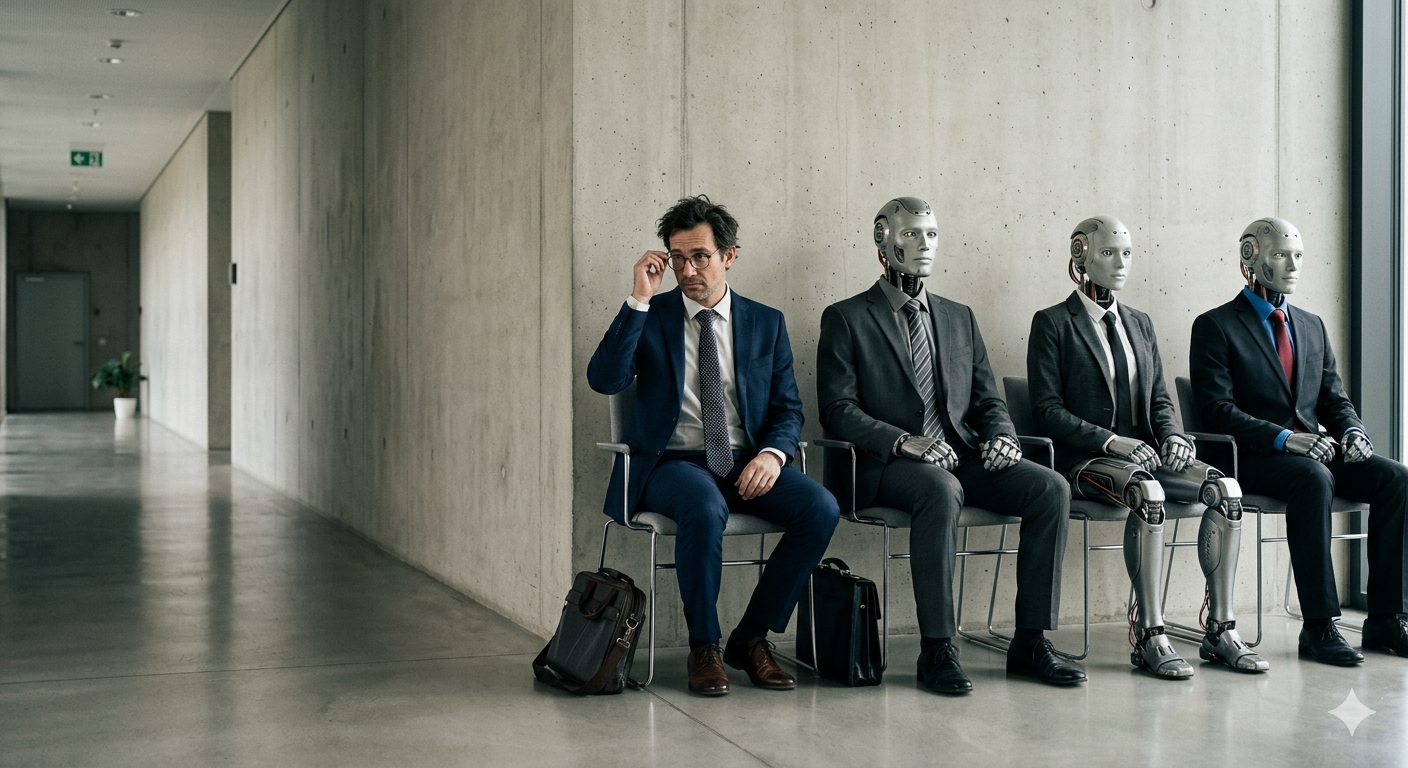
When your competition in the job market is literally built different. Illustration generated with AI
AI and the Job Market: The Reality Behind the Headlines
Recent news in Italy has reported cases of professionals, including engineers, being replaced by artificial intelligence. These stories tend to trigger immediate reactions: concern, frustration, and a growing sense that technology is shifting the world in a direction we cannot fully control.
This reaction is understandable. Work is not only a source of income, but also of identity and stability. When that feels threatened, the instinct is to look for something to blame. Artificial intelligence, in this context, becomes an easy target. What concerns me, however, is not the technology itself, but the way we relate to it.
The Myth of Opting Out: Why We Can’t Just Ignore AI
We often speak about AI as if it were an external force, something happening “out there” and beyond our control. This creates a subtle sense of distance, as if these changes belong to a world we feel we neither influence nor fully grasp. In response, some people choose to disengage. They avoid new tools, limit their interaction with technology, or reject it altogether, believing that distance offers a form of protection. This perception, however, does not reflect reality.
Most of us are already deeply integrated into digital systems. We use smartphones, payment platforms, streaming services, navigation tools, and cloud storage every day. We accept terms and conditions without reading them and allow applications to access personal data without questioning the implications. Our preferences, behaviors, and decisions are continuously recorded, analyzed, and fed back into the systems we interact with, where our own behavior becomes part of the data that shapes them. Participation is no longer optional; it is already part of how we live.
Because we cannot simply unplug, our ultimate defense is learning to protect our attention by practicing digital silence in a noisy world.
Uncritical Automation: The Hidden Risk of Probabilistic AI Tools
At the same time, the way we engage with these systems often remains superficial. It is becoming common to use AI tools to write, summarize, or make decisions without fully evaluating how they work, while assuming that the results are inherently reliable. In reality, these systems are probabilistic: they generate outputs based on patterns in data, not on verified truth or understanding. The issue, then, is not only what technology does, but how uncritically we engage with it.
AI is a tool — powerful, fast, and evolving — but still a tool. And like any tool, it depends on the hand that holds it. A hammer can build a house or break a window; the difference is not the hammer, but how it is used.
Why Digital Literacy is the Ultimate Skill in the Age of AI
The goal is not mastery, but a sufficient level of digital literacy to act with awareness. Understanding the basic logic of the systems we use, recognizing their limitations, and being mindful of how our data is shared are becoming part of everyday responsibility.
Much of the current anxiety is connected to the transformation of work. Roles are changing, and some will inevitably disappear. This is already happening, and it will likely continue. Even if it feels uncomfortable, this pattern is not new.
I recently came across a list of roles within a royal court — highly specialized positions that once carried prestige and responsibility. Most of them no longer exist today, and some are almost difficult to interpret from a contemporary perspective. This was not centuries ago, but little more than a hundred years back. What appears stable in one era can become obsolete in another, not as a failure, but as part of a broader transformation.
And yet, society did not stop. It evolved. New roles emerged, and new skills became valuable. This ongoing cycle reminds us that nothing we’re building is new—the structural disruptions we attribute to modern algorithms are simply the latest iteration of a pattern that has shaped human civilization for millennia.
Conscious Coexistence: How to Respond Constructively to Tech Transformation
The real risk, then, is not that change is happening, but how we choose to respond to it. Avoiding or ignoring technology may feel reassuring, but it does not reduce its impact or prepare us for what is already unfolding. If anything, it increases the gap between those who understand and those who do not.
A more constructive approach is to remain engaged, even at a basic level: to stay informed, to ask questions, and to develop a working understanding of the tools that are becoming part of our environment. This is not about competing with AI, but about coexisting with it consciously.
This does not require expertise, but it does require attention.
Technology will continue to evolve, reshape industries, and redefine the way we work and relate to each other, as it always has. What can evolve alongside it is our ability to engage with it more consciously.
The real difference may not lie in the pace of change, but in our willingness to understand it.
