Hacking the Horizon: the Race to Debug Death
As Silicon Valley turns the human condition into legacy hardware, we explore the high-stakes engineering of eternity
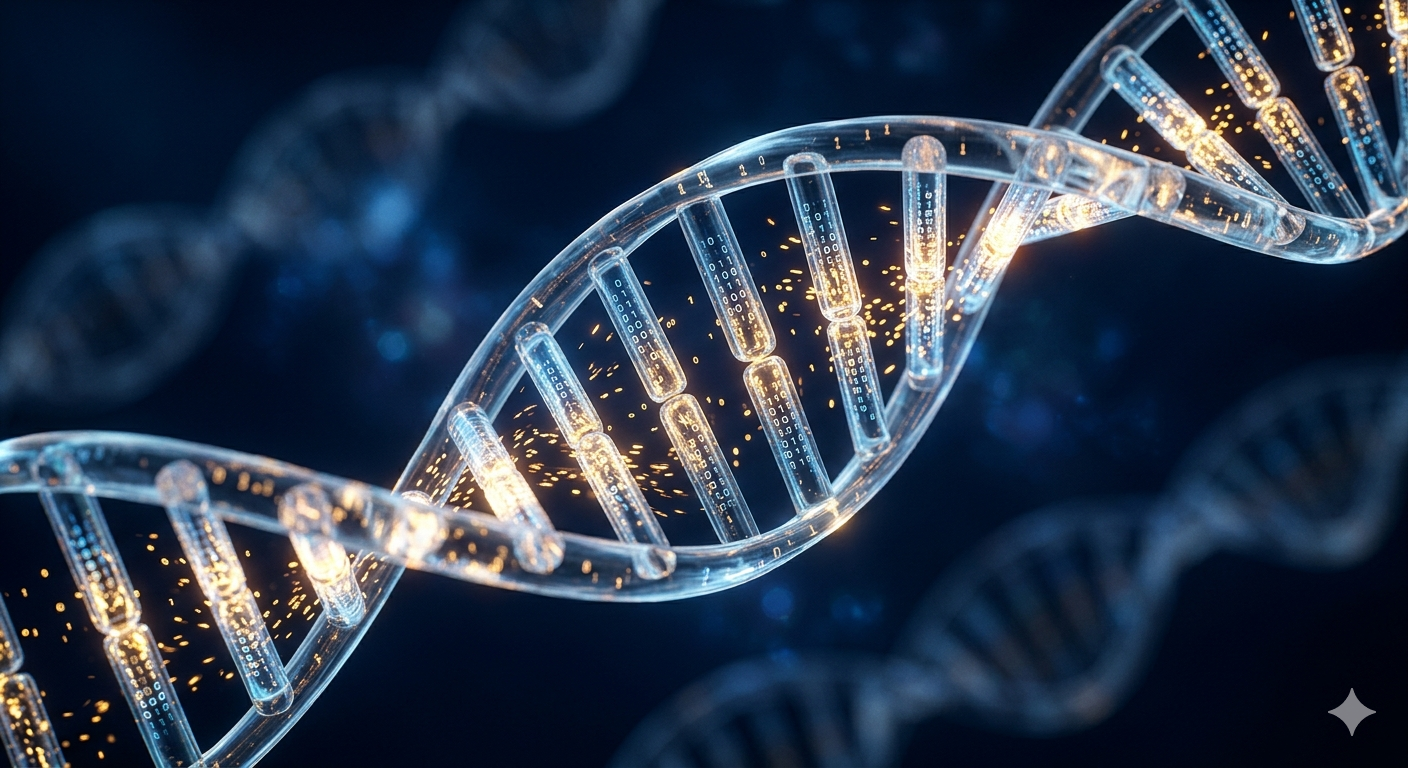
The 21st-century grave good: When DNA becomes the ultimate hard drive for the source code of our identity. Image generated with AI
"The first human to live 1,000 years is likely already alive." When Aubrey de Grey first claimed this, it sounded like cult prophecy. In 2026, it is the business plan for the world's most powerful men.
The quest itself isn’t new. From the alchemists’ elixir of life to religious promises of eternity, every era has sought a backdoor out of existence. Today this search has moved into the laboratory—and onto the corporate balance sheet.
Why the Elite Can’t Let Go
Our obsession with longevity is rooted in Terror Management Theory (TMT):the existential conflict between our survival instinct and the certainty of death. Historically, human culture—from the Pyramids to the Sistine Chapel—served as a defense mechanism against this fear. We built monuments because we couldn't save ourselves.
We are shifting from "accepting the mystery" to “debugging the system.” For the tech elite, death is no longer a natural conclusion; it’s a violation of human potential. They don't want a legacy; they want to stay in the room.
The Body as Legacy Hardware
In this paradigm, the body is a high-performance machine suffering from poor maintenance.
Bryan Johnson’s $2-million-a-year “Project Blueprint” is the terminal example. He isn't just "staying healthy"; he treats his organs like components in a server rack, monitored 24/7 by a phalanx of over 70 biomarkers and sensors. He is the pioneer of Biology as a Service (BaaS), proving that with enough data and discipline, the biological clock can be forced into reverse.
Meanwhile, the "Godfathers of Longevity"—Jeff Bezos (Altos Labs) and Larry Page (Calico)—are pouring billions into the ultimate software update: Cellular Reprogramming. By using "Yamanaka factors," scientists are instructing adult cells to hit a factory reset. The goal is to repair tissue damage before it becomes chronic, allowing a 60-year-old body to behave like a 20-year-old one.
We are moving toward an era where aging isn't an inevitable stage of life, but a biological bug. The death is no longer a theological mystery to be accepted; it is an engineering problem awaiting a solution.
The Backup Strategy
The toolkit for “Biological Patch” extends far beyond simple supplements, evolving into a sophisticated strategy of system redundancy.
At the cellular level, the front line of defense involves Senolytics, a precision "delete key" for the body’s aging infrastructure. These drugs target senescent "zombie cells"—which refuse to die and instead linger in the tissue, secreting inflammatory signals that decay surrounding systems. By purging this debris, researchers aim to restore the body’s internal environment to a more youthful state.
Yet, cleaning the hardware is only half the battle; Biometric Inheritance seeks to back it up. Here, DNA is the ultimate hard drive where we preserve the "source code" of our existence. Through private bio-banks and DNA encoded in synthetic crystals, individuals are creating emergency backups of their genetic sequence and stem cells.
The goal is a future where regenerative medicine can 3D-bioprint replacement organs—hearts, livers, or skin—matched perfectly to the original user.
For those whose hardware fails before the patch is ready, there is Cryogenics. Foundations like Alcor already host hundreds of patients in biological stasis, their bodies preserved in liquid nitrogen at -196°C. It is a gamble on a distant horizon—banking on a future where medical 'IT specialists' can finally repair the damage of time and perform a full system reboot.
The Social Minefield
As these technologies move from experimental labs to the market, the primary actors—Big Tech giants, biohackers, and the ultra-wealthy—are positioning themselves as the first "beta testers" of immortality. This creates a terrifying societal fracture: we are no longer just looking at a wealth gap, but a permanent Life-Expectancy Gap.
If death becomes a choice, it becomes a luxury good.
We risk a Biological Caste System where a tiny minority accumulates wealth and power over centuries, while the rest of humanity remains bound by the natural cycle. In this world, the social contract doesn't just bend; it shatters. When the 'haves' possess not just more money but centuries more time, the concept of meritocracy becomes a joke.
This leads to a deeper, more existential threat: Global Cultural Stagnation. Progress relies on what physicist Max Planck described as the idea that science advances "funeral by funeral." Science and society advance only when the old guard passes away to make room for new ideas.
Eliminating death creates a Gerontocracy of the Mind. Humans naturally lose cognitive flexibility as they age, an immortal elite would likely remain trapped in the ideologies and social norms of their youth. The leaders of 2026 are still the leaders of 2126. Every seat at the table of power, every board of directors, and every high-court bench remains occupied for centuries. The young are born into a world already "full," where the "new" is perpetually suffocated by the weight of an eternal, unmoving past.
The Cost of the Infinite
Mortality, for all its cruelty, provides the scarcity that gives human narrative its shape. It creates the urgency to love, create, and act. When time is infinite, the "now" becomes worthless.
We aren't necessarily seeking to live forever; we are simply refusing to disappear. We want absolute control over time, loss and identity. But a chilling paradox emerges: if we remove the finish line, does the race still have a point?
We are becoming a society of persistent traces—digital ghosts and biological machines—haunted by the fear of being forgotten. By trying to become the gods of our own biology, we risk losing the friction that makes life meaningful. A world that refuses to die is a world that no longer knows how to grow.
The code is being rewritten, but as we reach for the dial to turn off the end, we must ask: Is a story that never ends still worth reading?
