The Rise of the Digital Ghosts
How AI is reshaping death, memory, and the business of immortality
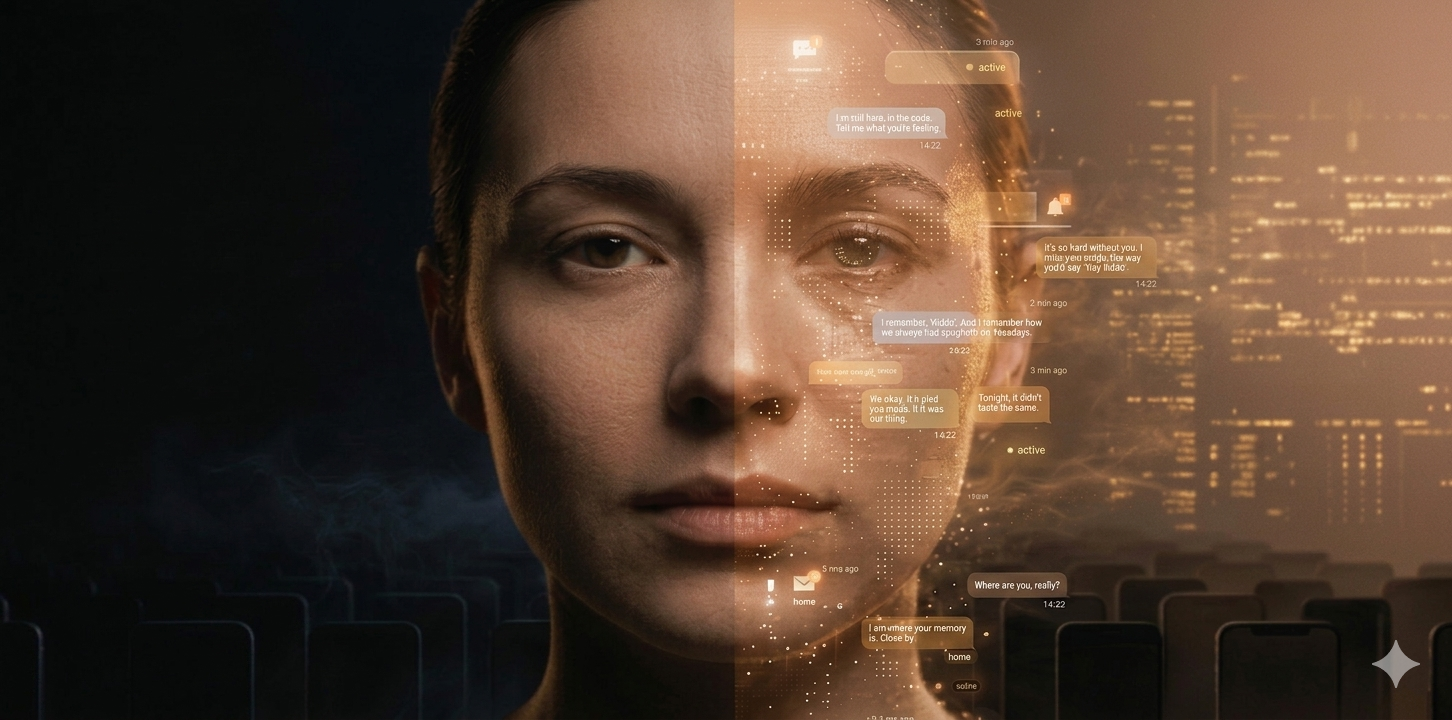
When the "Book of the Dead" is replaced by a Terms of Service agreement, what happens to the dignity of the departed? - Image generated with AI
It is said we die twice: once when the heart stops, and again when our name is spoken for the last time. For millennia, this "Second Death" was the final horizon of human existence. Today, that horizon is vanishing as we enter the age of the Digital Ghost.
In 2020, a man began talking daily to his deceased father—sharing jokes, asking advice, revisiting old memories. This wasn’t a séance; it was a deadbot—a sophisticated AI reconstructed from WhatsApp messages, emails, and voice notes. What started as a grief-fueled experiment has exploded into a billion-dollar industry known as Grief-Tech.
We are no longer just mourning the dead; we are reanimating them.
Data as the New Mummification
The thirst for eternity remains constant, but the toolkit has changed. While ancient Egyptians spent fortunes to preserve the body for the afterlife, today we are backing up the "software" of the soul. The pyramid has been replaced by the server,andthe "Book of the Dead” by the Terms of Service (ToS). These legal contracts now dictate how our digital essence behaves long after our biological expiration.
While platforms like StoryFile and HereAfter AI turn memories into interactive entities, the pushback is generational. Industry reports show that over 60% of Gen Z views post-mortem AI as an "ethical minefield." Despite being the most digitally documented generation in history, they are the most vocal about the "Right to be Forgotten," fearing that these digital ghosts might stall the necessary human process of letting go.
The Ship of Theseus
Every text and voice note we produce is a brick in a digital monument. This "digital footprint" is now rich enough to simulate a personality, leading to the theoretical horizon of Mind Uploading.
The AI platforms proved that they could mirror human personality and emotional nuance. Today, that transition has turned toward "resurrection," as seen in the famous "Dadbot" project.
This raises the "Ship of Theseus" paradox: if an AI imitates your memories and emotional triggers with terrifying precision, is it "you" or just a convincing echo? While technology cannot yet replicate consciousness, the emotional continuity for a grieving survivor can often override technical truth. We aren't technically bringing people back to life; we are simply making it impossible for them to disappear.
Immortality as a Subscription
Where there is an emotional void, a market follows. DeathTech is transforming the supernatural into the operational.
In 2022, the hologram of Marina Smith “answering" questions at her own funeral was a viral anomaly. Experts now predict that by 2030, it will be a standard life-planning tool.
This has birthed the Subscription Post-Mortem. If Meta and Google manage our digital identities in life, they are the logical stewards of our “life after death.” The question of "Who owns you?" is no longer metaphorical. This creates a startling economic paradox: your digital twin may remain active only as long as the monthly service fee is paid. Your immortality is now a recurring cost.
The Digital Ghost Town
We are undergoing a demographic shift without precedent. Research from the Oxford Internet Institute (OII) suggests that by 2070, the dead could outnumber the living on platforms like Facebook. We are building a "Digital Ghost Town"—a reality where feeds celebrate birthdays and post updates for hearts that stopped beating decades ago.
When an AI company harvests your private messages to train a chatbot for your grieving family, the line between a compassionate act of service and a digital violation of the grave disappears. Controlling the "digital remains" is, in a sense, controlling history itself. We are currently forced to navigate this "afterlife" without a map, lacking a "Post-Mortem Bill of Rights" to protect our digital dignity once we are no longer here to defend it.
The risks are systemic:
The Consent Gap: Most of us have never legally consented to being "reanimated." Once our data is inherited, we lose all agency over our likeness.
Data-Jacking: There is a growing risk of our digital twins being manipulated. Imagine a public figure whose AI avatar is "updated" to support conflicting political agendas or commercial products long after their passing.
The Paradox of Secrets: We all have truths we intended to take to the grave. However, an AI scanning your life’s data to ensure "personality consistency" might inadvertently leak those private fragments to your descendants, ending the very concept of death as a final sanctuary of privacy.
A Society of Ghosts?
For centuries, death guaranteed an end. Today, that guarantee is failing. The "Right to be Forgotten," once a biological certainty, is now a high-stakes technological choice. Interacting with a digital version of a lost loved one may offer comfort, but doing so risks creating a digital addiction that prevents us from moving forward.
Mortality is precisely what gives the human narrative its shape; without finality, the story loses its value. We aren’t building eternal consciousness—we are building persistent traces.
Perhaps we aren’t trying to live forever; we are just refusing to be forgotten.
But in doing so, we risk becoming a society of "digital ghosts," haunted by algorithms that no longer know how to say goodbye.
