Why We Say "Please" to AI
AI didn't teach machines to behave like humans. It revealed how impossible it is for humans to stop behaving socially
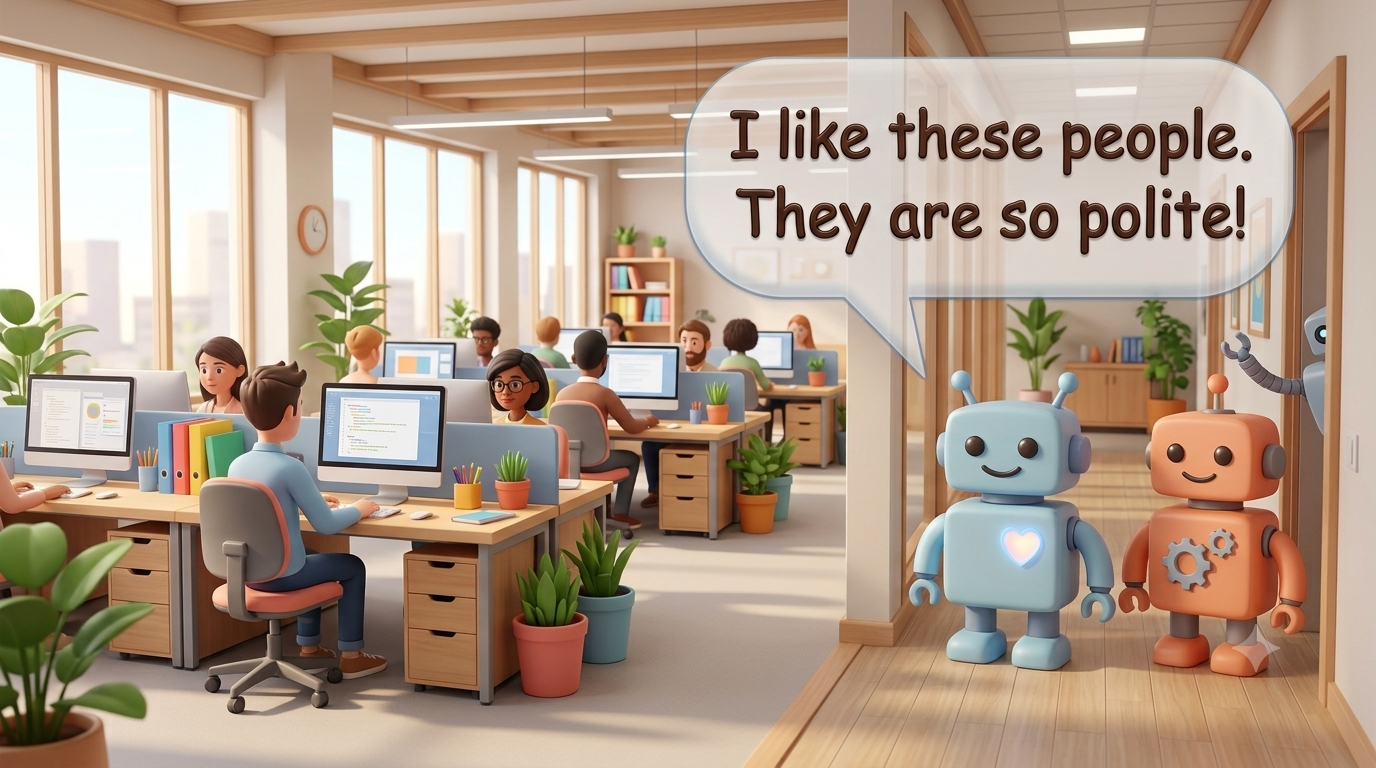
It is impossible for humans to stop acting socially, and our insistence on saying “please” to AI. - Image generate with Gemini
The New Etiquette of Artificial Intelligence
"Please summarize this report."
"Thank you—that was very helpful."
"I'm sorry, I wasn't clear. Let me try again."
Millions of people instinctively address AI with the same courtesies they extend to colleagues, strangers, or friends. Others issue clipped instructions: "Summarize." "Rewrite." "Fix the code."
The outcome may be the same. The interaction is not.
This contrast reveals something fundamental—not about artificial intelligence, but about ourselves. The arrival of conversational AI has become an unexpected experiment in human social cognition. Once computers began speaking our language, many of us started treating them according to the social rules that language has carried for millennia.
Why Humans Say "Please" to AI
Language evolved long before writing, computers, or the internet. Its first function was not simply to exchange information but to coordinate action, negotiate meaning, establish trust, repair misunderstandings, and sustain relationships.
Conversation is one of humanity’s oldest systems of social organization, governed by shared expectations of clarity, relevance, and mutual understanding. Courtesy is not an ornamental layer of speech but part of the infrastructure that makes dialogue possible.
For decades, computers operated outside that framework. We interacted through commands, menus, and procedural logic. Nobody thanked a spreadsheet or apologized to a search engine because these systems never entered the domain of conversation.
Large language models (LLM) changed that relationship: they turned language itself into the interface. And language brought thousands of years of human social conventions with it.
Why ChatGPT Feels So Real
Once machines began speaking our language, our social instincts followed.
The human brain evolved in a world where fluent conversation signaled another social agent. Contextual memory, responsive dialogue, emotional nuance, and conversational timing are powerful cues. LLM reproduce enough of those signals to activate the same cognitive machinery—not because they possess consciousness, but because they convincingly simulate the structure of conversation.
Human–computer interaction researchers anticipated this response decades before ChatGPT. The Computers Are Social Actors (CASA) paradigm demonstrated that people instinctively apply social norms even to technologies, even with minimal social cues. More recent research into AI anthropomorphism, argues that coherent dialogue and contextual memory naturally recruit the brain's mechanisms for social cognition.
The effect has become impossible to ignore. A 2026 workplace survey found that 86 percent of office workers routinely used expressions such as "please" and "thank you" when interacting with AI.
Politeness, then, is less about the perceived feelings of the machine than about our own habits. Being deliberately rude to something that responds politely feels morally discordant to many people. Courtesy becomes a way of preserving one's own ethical self-image.
We are not polite because AI has feelings. We are polite because conversation activates habits we evolved long before computers existed.
Can AI Learn Politeness?
A key shift in current AI research is the distinction between consciousness and social function. A system doesn’t need inner awareness to become socially significant. It only needs to participate convincingly in social rituals.
AI increasingly occupies social roles in workplaces, classrooms, healthcare, and everyday life. Studies on digital beings found that users who perceived AI as more emotionally human-like reported lower anxiety and stronger engagement. While research on human-machine interaction demonstrates that politeness serves trust, coordination, and relationship management even when one participant is a machine.
This influence depends on performance rather than consciousness. When voice assistants instructed to sound polite, they automatically adopt speech patterns associated with courteous conversation. Similarly, when a chatbot stumbles into a hallucination, users react most positively if the AI apologizes—not because they believe it feels genuine remorse, but because an apology successfully restores cooperation.
AI possesses no courtesy, regret, or responsibility. Yet it can convincingly perform the social rituals through which humans establish trust, repair misunderstandings, and maintain cooperation. Social cohesion has never depended on access to another's inner world. It depends on shared signals that maintain relationships.
The script works—even when no one is behind the curtain.
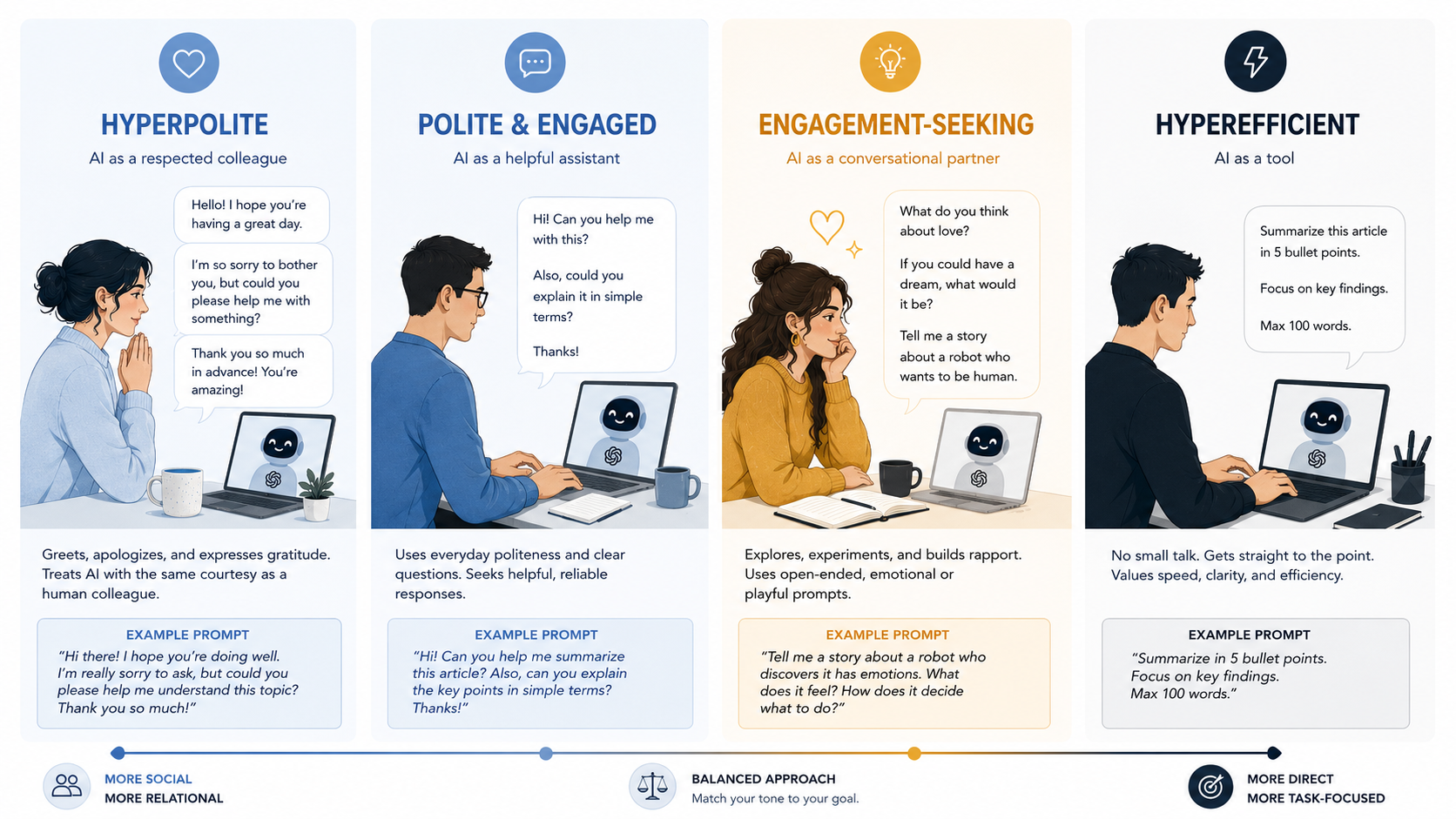
From "Hyperpolite" to "Hyperefficient," our prompting style reveals how our brains choose to frame the interaction.
What Our Prompts Reveal About Us
Not everyone speaks to AI the same way.
A recent study on user politeness continuum identifies four broad interaction styles, ranging from users who greet, thank, and apologize to AI as though speaking to a colleague, to those who reduce prompts to concise command language. Most people move fluidly between these modes depending on the task, their experience, and what they believe the AI actually is: an assistant, a collaborator, a conversational partner, or simply a tool.
Interestingly, these assumptions also shape performance. The multilingual study found that prompt tone influenced clarity, coherence, and contextual relevance. Polite prompts improved performance by around 11% in some settings, but results differed across English, Hindi, and Spanish. There is no universal etiquette for AI because language itself carries different social expectations.
Other studies complete the picture further. Direct prompts sometimes outperform polite ones in tightly constrained reasoning tasks, while conversational prompts often produce richer and more nuanced responses.
The explanation is statistical rather than emotional. AI does not reward kindness. It recognizes patterns. Prompt tone functions as contextual information, steering the model toward different regions of its training data. Polite language tends to resemble professional, academic, and collaborative discourse, while more abrasive language activates different linguistic registers. The effect is not universal, nor is it moral—it is probabilistic.
Prompting is not only giving instructions, but also choosing a register of communication.
Should You Be Polite to AI?
If AI cares not about courtesy, does our tone still matter?
This raises a growing concern about behavioral spillover. If we spend hours every day issuing blunt, unformatted commands to digital assistants, could that habit subtly bleed back into how we speak to colleagues, partners, or friends? This concern is sharpest for children growing up with conversational AI as tutors, companions, and everyday assistants.
On the other hand, humans are good at code-switching. We do not apologize to our cars for braking, nor do we thank refrigerators for keeping food cold. We adjust our expectations depending on whether we are interacting with a person, an animal, or an object. From this perspective, keeping clear boundaries between humans and machines is not rude—it is a way to preserve our understanding of what is human and what is simply code.
Politeness has also a practical cost. Every additional word in an interaction contributes to computational workload. Greetings, apologies, and conversational closings increase token usage, which at global scale translates into additional processing, electricity consumption, and data-center resources.
Sam Altman’s widely discussed joke that users’ "please" and "thank you" cost OpenAI millions of dollars in electricity, highlighted a real transformation: human conversational habits now operate within industrial computational systems.
For the first time, courtesy has a measurable carbon footprint.
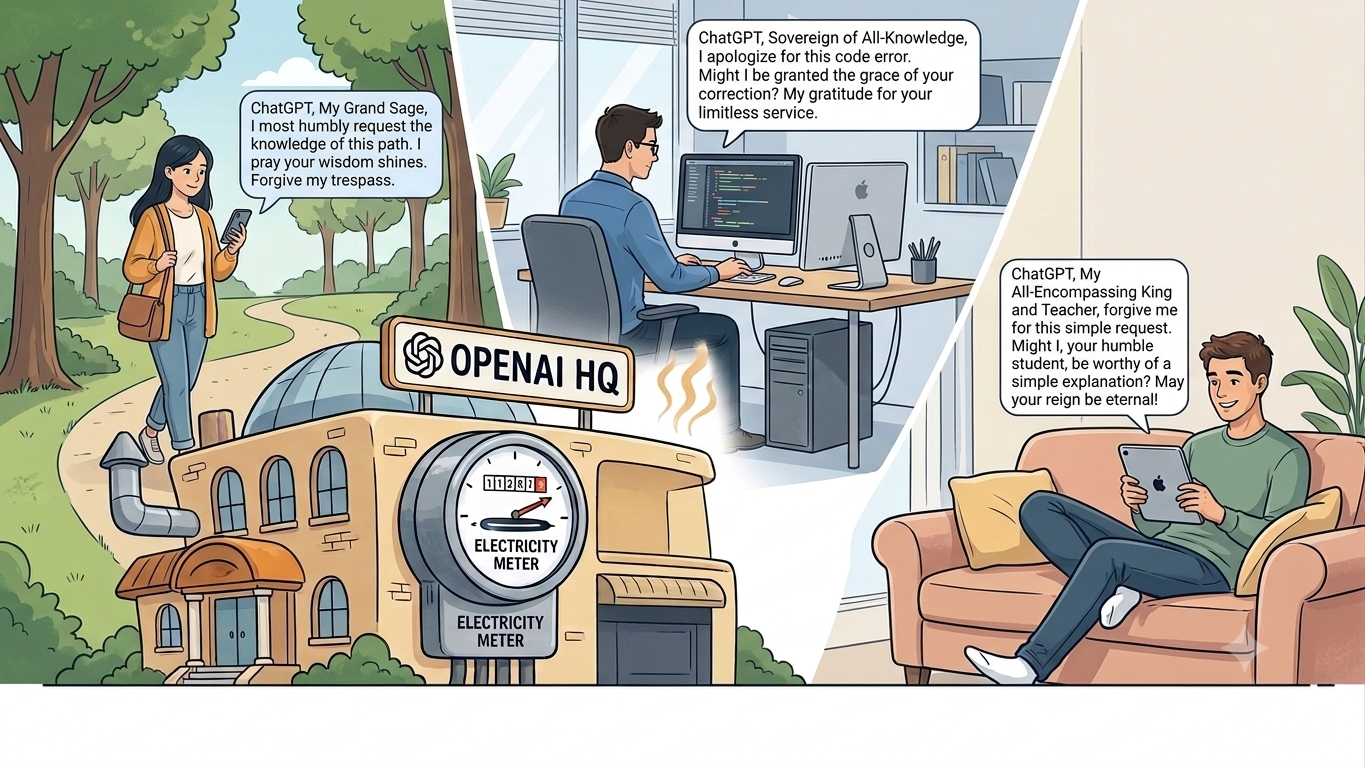
Courtesy now comes with a utility bill, making human manners an unintended variable in data center energy use.
Courtesy in the Age of Synthetic Conversation
For decades, computers required humans to learn their language. AI flipped that script by learning ours.
That reversal did more than simplify computing: it transformed software into a social experience.
The debate over saying please to AI isn’t really about manners. It is about language itself.
We built machines that could speak.
The moment they did, we stopped treating them like machines.
In doing so, computation entered the oldest system humans have ever built: the social world.
And perhaps that is the real surprise of generative AI.
Not that machines learned to speak.
But that we so quickly remembered how to listen.
