Why Robots Look Like Us
Humanoid robots are becoming labor infrastructure designed for a civilization built around the human body
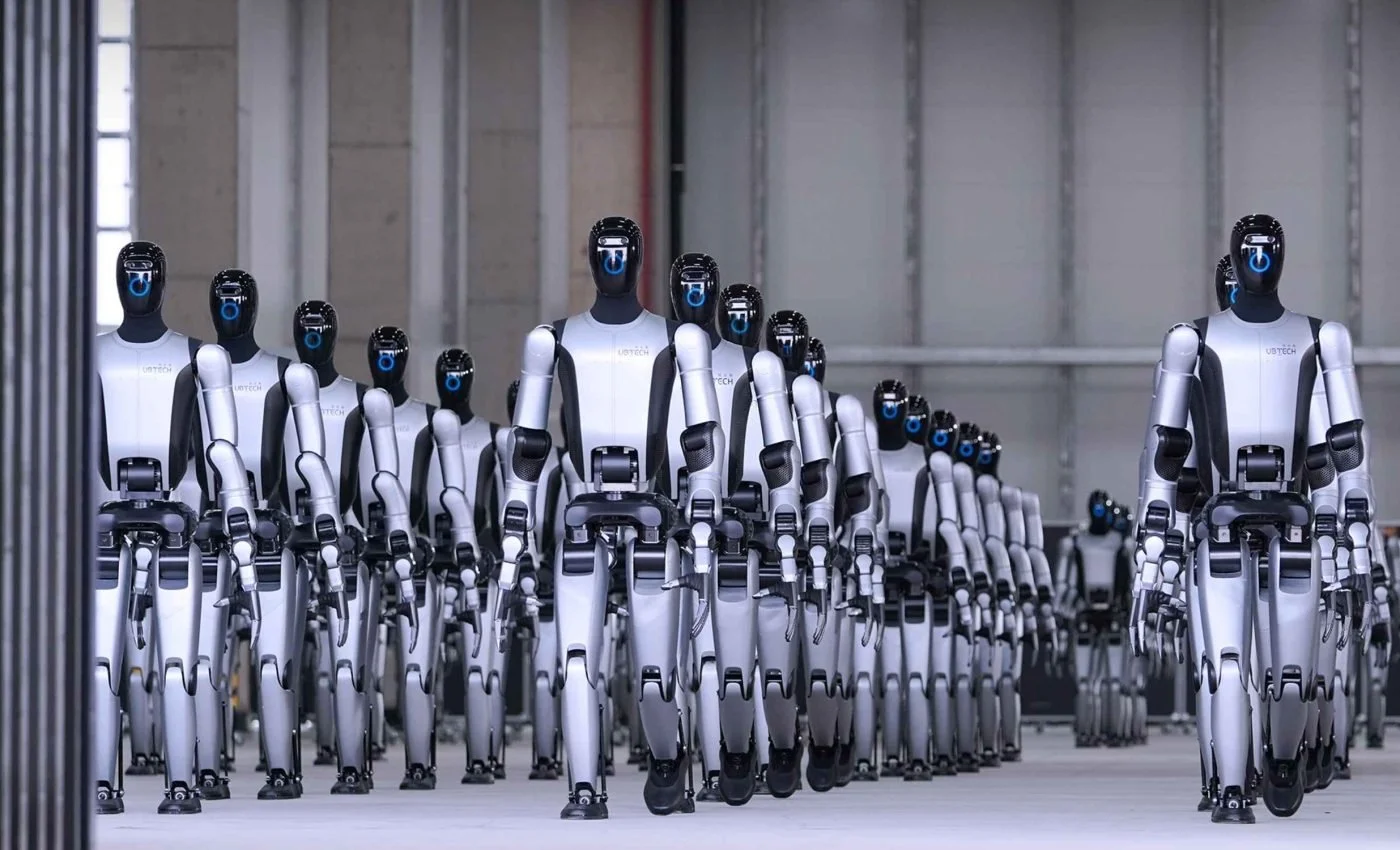
An intentional subtraction of identity: modern humanoids abandon hyper-realistic faces to signal utility. Photo: UBTECH Robotics/YouTube
Everywhere you look, humanoid robots suddenly seem to be arriving at once.
They dance on TikTok. They appear on stages beside CEOs promising a new industrial revolution. Tesla continues showcasing Optimus. Figure AI signed partnerships with BMW. Chinese companies like Unitree and AgiBot are scaling aggressively with state-backed momentum. What only a few years ago looked like a niche research category has become a global commercial race.
And the speed of that transition is startling.
Industry analysts estimate that global humanoid robot shipments surpassed roughly sixteen thousand units in 2025 — a dramatic increase from just a few thousand units the previous year. By consumer-tech standards, those numbers are still small. But economically, something important has shifted: humanoids are no longer being presented as futuristic curiosities. They are increasingly being discussed as labor infrastructure.
The obvious question is: why now?
What Changed? The Rise of “Physical AI”
The answer is not a single technological breakthrough, but the collision of several maturing systems at once.
For decades, robots were notoriously brittle. Even simple tasks required enormous amounts of hardcoded instructions, and machines often failed the moment environments became unpredictable. Traditional industrial robots worked well only because factories themselves were redesigned around them: isolated cages, repetitive motions, perfectly controlled conditions.
Artificial intelligence changed that dramatically. Modern humanoids can increasingly combine vision, language, and movement in real time. Instead of executing only rigid pre-programmed commands, a robot can now receive an instruction like “pick up the blue crate near the shelf,” identify the object visually, and translate that request into physical motion. Researchers increasingly describe this transition as the rise of “Physical AI”: intelligence capable not only of processing information, but of operating inside the physical world.
At the same time, robots began training inside massive virtual simulations before ever entering reality. Instead of learning slowly through physical trial and error, machines now rehearse millions of movements digitally — accelerating development dramatically. Increasingly, robots are also learning directly from human demonstrations, raising the possibility that future systems may eventually share learned skills across entire robotic networks.
Hardware improved just as quickly. The electric vehicle boom lowered the cost of batteries, sensors, cameras, and compact motors, making humanoid platforms far cheaper and more viable at industrial scale. Even mobility and dexterity — once among robotics’ hardest unsolved problems — advanced rapidly. Not long ago, keeping a bipedal robot balanced was considered an achievement. Today, some humanoids can run, lift cargo, climb stairs, and manipulate fragile objects with surprising precision.
Still, the deeper reason humanoids matter is not technological. It is architectural.
The Hidden Reason Humanoids Make Economic Sense
Modern civilization was built around the human body. The height of a staircase, the width of a corridor, the shape of tools, the position of shelves, elevators, door handles, warehouse aisles, factory stations — nearly every physical environment on Earth assumes a worker with two arms, two legs, and human-scale movement. Civilization itself is anthropocentric infrastructure.
For most of industrial history, automation required us to violate that infrastructure. Factories became sterile environments designed around the rigid logic of machines. Humans adapted themselves to assembly lines, cages, and repetitive industrial geometry.
Now, that relationship is beginning to invert. Instead of redesigning civilization around robots, engineers are redesigning robots around civilization.
This is why the humanoid form suddenly makes economic sense.
From a pure engineering perspective, humanoids are actually inefficient machines. Wheels are often more practical than legs. Specialized robotic arms still outperform humanoids inside tightly controlled environments. But humanoids are not designed for perfect efficiency inside ideal conditions. They are designed for compatibility with a world built long before they existed.
From a corporate perspective, adapting robots to our existing infrastructure may ultimately prove far cheaper than redesigning global infrastructure for robots.
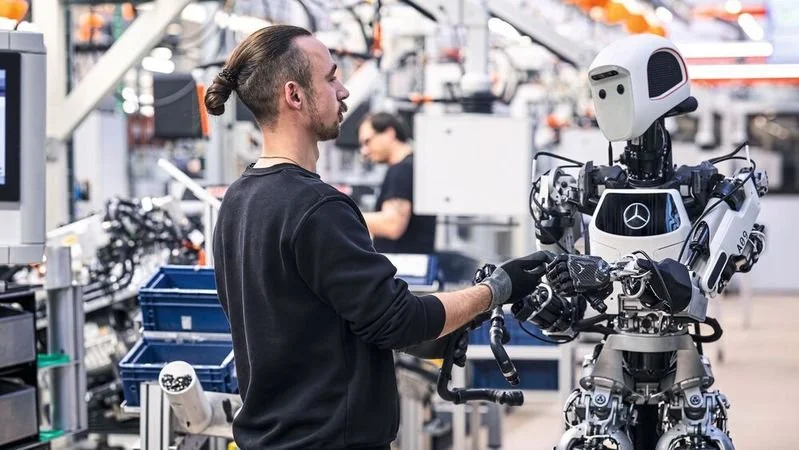
The geometry of coexistence: A worker interacts with a humanoid robot on the factory floor, illustrating a shift toward machines designed to fit our existing industrial infrastructure. Photo: Mercedes-Benz AG
Civilization Was Built Around the Human Body
That calculation arrives at a moment of mounting economic pressure. Across much of the industrialized world, labor shortages are becoming structural rather than temporary. Populations are aging, birth rates are declining, and industries built around repetitive physical labor are struggling to recruit workers. Simultaneously, logistics systems increasingly operate under relentless demands for speed, continuity, and instant fulfillment.
Humanoids promise something previous automation struggled to achieve: the ability to enter messy, dynamic human environments without requiring those environments to change first.
And this is where the technology becomes culturally unsettling.
A humanoid robot does not merely automate a task. It occupies a space historically reserved for the human body itself. It walks through our corridors, climbs our stairs, uses our tools, and navigates spaces built around human anatomy. For the first time, machines are not simply entering factories — they are entering the physical grammar of civilization.
Why Modern Robots No Longer Want Human Faces
Interestingly, modern humanoids rarely try to look fully human anymore. Early robotics prototypes often attempted hyper-realistic faces and artificial skin, triggering the now-famous “uncanny valley”: the psychological discomfort humans feel toward things that appear almost, but not entirely, human. Most robotics companies have since abandoned that strategy entirely. The dominant aesthetic of 2026 is minimalist and faceless — smooth visors, matte surfaces, simplified geometry.
The machine no longer tries to imitate human identity. Only human functionality.
That distinction matters psychologically. A faceless humanoid is easier to tolerate because it presents itself as infrastructure rather than companionship. Yet the effect remains strangely uncanny: the body is familiar, but the social signals are gone. We instinctively rely on facial expressions, eye contact, and subtle emotional cues to navigate shared spaces. A humanoid worker removes those signals while preserving the physical presence itself.
The result is a machine that feels simultaneously ordinary and alien.
The Real Ethical Question Isn’t Job Loss
This may ultimately become the deepest tension surrounding humanoid robotics. The historic automation debate was largely confined to repetitive factory labor inside controlled industrial settings. Humanoids expand that frontier into the adaptive, unpredictable environments we once considered uniquely human precisely because they required movement, judgment, and physical flexibility.
The challenge ahead is not simply whether robots will replace certain forms of labor.
It is whether humans are prepared for a world in which we are no longer the only entities naturally compatible with the architecture of civilization itself.
